Porsche Coolant Loss and Overheating: How to Find the Leak
The documented coolant weak points on 911, Boxster, Cayman, Cayenne and Macan models, and a safe, methodical way to find a leak before it turns into an overheated engine.
In this article
- What the warning on your dash is telling you
- Known weak points, model by model
- Front-radiator cars: the 986, 996 and their relatives
- First-generation Cayenne: start with the pipes
- Newer Macan, Cayenne and Panamera: rule out the known bulletins
- How to find the leak: pressure first, then dye
- Refilling: right coolant, no air
- The practical close
Coolant loss on a Porsche rarely announces itself with a dramatic puddle. More often it is a faint sweet smell after a drive, a low-coolant message that comes back a week after you topped up, or a temperature needle that sits a little higher than it used to. Those are the cheap moments to find the leak.
The expensive moment is the one where the engine overheats. On aluminum engines, FCP Euro warns that even a short time overheating can cause head gasket, block and cylinder head damage.[1] So the goal here is simple: know where your model tends to leak, confirm the actual source with a pressure test, and fix that, rather than replacing half the cooling system on a hunch.
What the warning on your dash is telling you
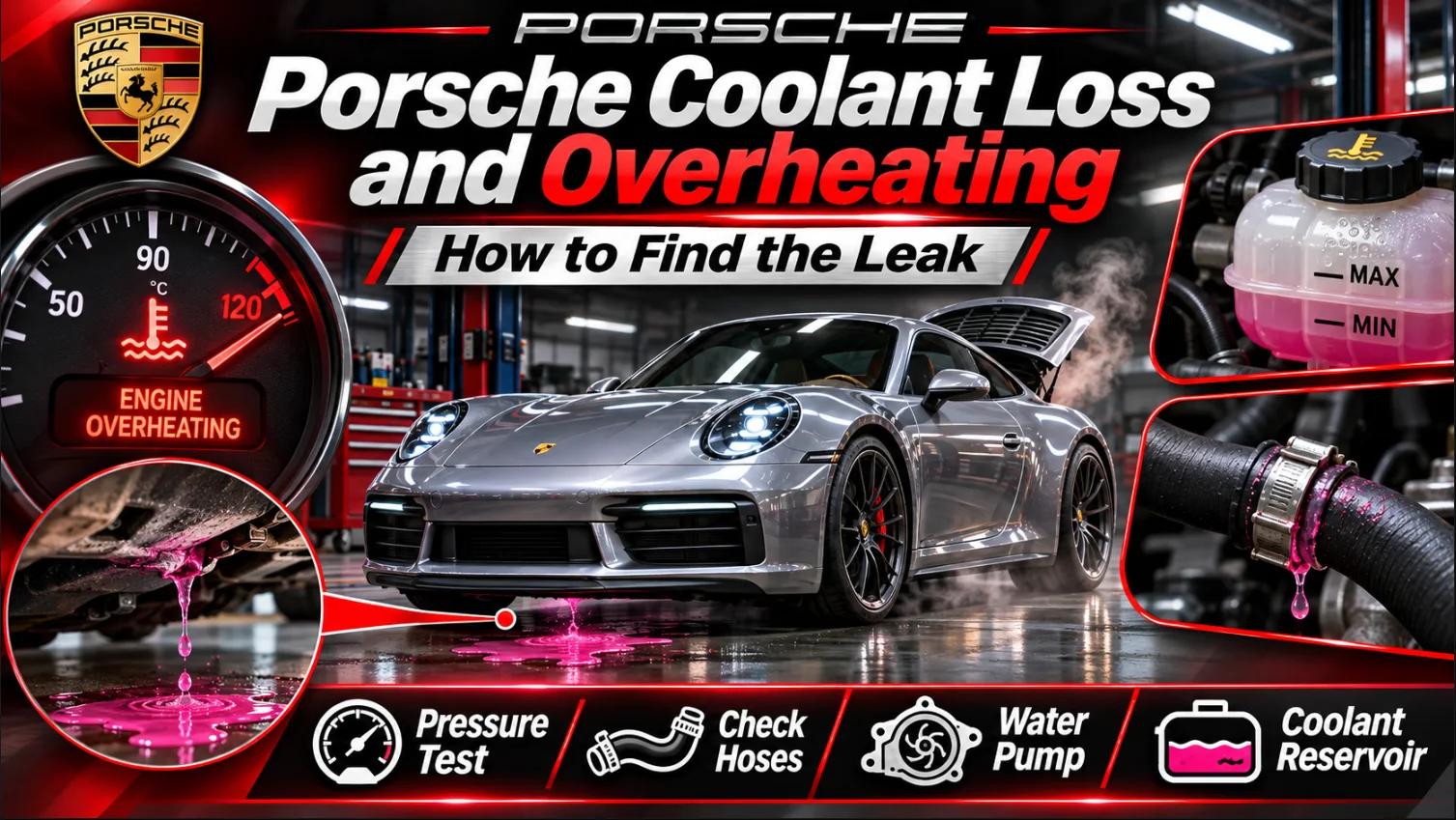
A low-coolant message and an over-temperature warning are different problems with different urgency.
A low-coolant warning means the level in the expansion tank has dropped. Brake & Front End notes the car may never overheat, and that topping off often just delays the message coming back.[9] It is a request to find the leak.
An over-temperature warning means stop. Porsche's own owner's manual text, quoted in a 2023 technical bulletin, says to stop as soon as it is safe, switch off the engine and let it cool, check the radiators and air guides for obstructions, check coolant and oil levels and add coolant if needed, and see a Porsche dealer if the fault persists.[5] That checklist is a good one for any model.
Known weak points, model by model
| Model / engine | Documented weak points | What you typically notice |
|---|---|---|
| 986 Boxster and 996 911 (M96) | Front radiators clogged by debris and cracking plastic end tanks; water pump bearing wear with a plastic impeller; expansion tank cracking[2] | Higher cruising temperature, coolant at the front of the car, or coolant in the engine bay and rear trunk area[2][3] |
| 996, 997, 986, 987 expansion tank | Underside of the tank hardens and cracks over time[4] | Small puddle after a long drive; leak above the exhaust[4] |
| 996/997 Turbo, GT2, GT3 (Mezger) | Coolant pipe failures on the GT1-based engine[1] | Specialists often fix the pipes with the engine out, and change the expansion tank at the same time[4] |
| Cayenne 955 4.5 V8 (2003 to 2006) | Plastic coolant pipes in the engine valley under the intake; expansion tank cracks; return hose T fitting on Turbos[1] | Coolant smell, low tank, coolant running down the back of the engine[1] |
| Cayenne 957 4.8 V8 (2008 to 2010) | Glued rear crossover pipe barb; plastic valley pipe; bonded pipes at the thermostat housing; water pump[1] | Sudden massive leak at the rear of the engine if the barb lets go[1] |
| Cayenne 955/957 V6 (VR6) | Plastic pipe between water pump and thermostat housing (3.2); plastic thermostat housing; water pump[1] | Sudden total coolant loss from the middle of the block on the 3.2[1] |
| Macan V6, Cayenne 9YA/9YB, Panamera 971 (2017 to 2021 ranges) | Water pump vacuum changeover valve can stick[5] | "Coolant temperature too high" warning[5] |
| 2023 Macan and Macan T (campaign vehicles) | Coolant regulator seal out of spec[6] | Gradual coolant loss and a yellow warning[6] |
Front-radiator cars: the 986, 996 and their relatives
Mid- and rear-engine Porsches put their radiators in the front bumper corners, a long way from the engine. FCP Euro describes those bumper openings as prone to collecting debris that blocks the radiators, raising cruising temperature and straining the system. The most common result is failed radiators with cracked plastic tanks, and hoses can tear as well.[2] FCP's 996 radiator guide lists overheating in normal driving and coolant leaking from the front of the car as the signs of a failing radiator, and notes debris falling out of the ducting when it is removed.[3]
Back at the engine, FCP reports that water pumps on M96 engines wear relatively quickly, with the bearing developing play. Because the original impellers are plastic, a failing pump can contact the engine case and send plastic fragments through the cooling passages.[2] Excellence adds that a failing pump bearing sometimes growls or scrapes before it lets go, but it can also fail without warning.[7]
The expansion tank is the other repeat offender. SharkWerks describes the underside of the tank on water-cooled 996 and 997 cars, including the Turbo and GT models, hardening and cracking and leaking onto the engine, and notes the same tank issue on Boxster and Cayman.[4] Because the crack is on the bottom, you will not see it with the engine lid open.
FCP also cautions that not every coolant loss is external. On these engines it mentions oil-to-coolant heat exchanger failures and, worse, head gasket failures and cylinder or head cracks that let coolant into the combustion chamber.[2]
First-generation Cayenne: start with the pipes
If a 2003 to 2006 Cayenne S or Turbo with the 4.5 V8 is losing coolant, FCP Euro says the plastic coolant pipes under the intake manifold are often the cause. They are known to crack, Porsche released an updated aluminum pipe kit, and FCP reports that Porsche lost a class action related to them. The symptoms are a coolant smell, a low expansion tank, and coolant running out from under the intake toward the transmission.[1] Leaking coolant from those pipes can also damage the starter sitting below them.[1]
The 2008 to 2010 4.8 V8 changed the design, but FCP lists new weak points: a rear crossover pipe with a glued hose barb that can loosen and dump coolant all at once, a plastic valley pipe, and pipes bonded into the thermostat housing.[1] Expansion tanks crack across first-generation Cayennes, usually showing up as coolant near the front passenger side.[1]
On these engines FCP recommends replacing the water pump and thermostat together, and notes a stuck thermostat shows up as overheating (stuck closed) or an engine that never warms up (stuck open), usually with a check engine light.[1]
Newer Macan, Cayenne and Panamera: rule out the known bulletins
Not every warning is a leak. Porsche's bulletin 2307 covers "Coolant temperature too high" messages on 2017 to 2021 Panamera (971), 2019 to 2021 Macan with six-cylinder engines and 2019 to 2021 Cayenne (9YA, 9YB). The cause it names is a vacuum changeover valve controlling the water pump's sleeve that can intermittently stick, and dealers are directed to a specific coolant pump and valve function test.[5]
For some 2023 Macan and Macan T vehicles, Porsche opened workshop campaign WRK2 because coolant regulators may have a shaft seal that does not meet specification, causing gradual coolant loss and eventually a yellow warning. The fix is a new coolant regulator housing, and only vehicles assigned to the campaign are covered.[6] If your Macan or Cayenne is under warranty or near it, a dealer check of open campaigns and bulletins comes before any DIY work. Our 2026 recall roundup and Macan common problems guide cover more.
How to find the leak: pressure first, then dye
1. Look and smell, cold. With the engine cold, check the tank level, then look for dried crust or wet spots at the tank, hoses, pump area and radiators. Remember that where the drip lands is not always where it starts.[8]
2. Pressure test. A cooling system pressure tester attaches at the tank or cap opening and brings the system up to operating pressure without running the engine, so you can look for leaks without moving belts and hot exhaust nearby.[9] Never exceed the pressure rating on the cap; over-pressurizing can create leaks that were not there.[9] Porsche's own campaign tool list includes coolant tester adapters for this job.[6]
3. Read the result. If the system will not hold pressure for around ten minutes and nothing is visibly leaking, Brake & Front End says that points to an internal leak such as a head gasket or a cracked head or block.[8] A shop can confirm that by sniffing for combustion gases at the tank opening.[8]
4. UV dye for the hard ones. For small or hidden external leaks, add UV dye to the coolant, run the engine, then scan with a UV light.[8] Check with the manufacturer before adding dye, since some prohibit it.[8]
Refilling: right coolant, no air
Use the coolant your owner's manual specifies. A Porsche dealer points out that coolant color is not a reliable guide to type, and that many models are not compatible with "universal" coolants.[11] FCP Euro states that the first-generation Cayenne coolant should not be mixed with common parts-store coolants.[1] If you are unsure what is in the system, flush and refill rather than mixing.
Air is the other enemy. The long coolant path on front-radiator cars makes bleeding difficult, and FCP says Porsche recommends a vacuum filler for the 996.[3][2] Exact capacities and the bleeding procedure belong to the workshop information for your specific car.
The practical close
Coolant loss on a Porsche is usually a known part failing in a known place: a cracked tank, a tired pump, a radiator choked with leaves, or the Cayenne's infamous pipes. Find it with the engine cold and a pressure tester before buying parts, and treat an over-temperature warning as a stop sign, not a suggestion.
The TekGarage app shows live coolant temperature through an OBD adapter, which makes a slowly rising trend easier to catch early, and it lists known failure points for your car. If the pressure test points inside the engine, talk to us through diagnostic help before deciding on a teardown.
Sources
- The Definitive Guide To First-Generation Porsche Cayenne Engine Options (955/957)
- 5 Of Our Favorite Cars With Notoriously Unreliable Cooling Systems
- How To Replace & Upgrade Porsche 996 Radiators (Carrera 3.4L & 3.6L)
- Is coolant leaking from your 996 or 997? It could be your coolant expansion tankPorsche specialist shop and parts seller; publication date not shown.
- Advanced Technical Information Bulletin 2307: Display of "Coolant temperature too high" in Group V6 and V8 Engines
- Technical Information 106/24: WRK2 Replacing Coolant Regulator (Workshop Campaign)First published December 13, 2024; revision 2 dated April 10, 2025.
- Technical Issues: 5 Common Porsche Problems
- Leak Detection Tools & Equipment
- Diagnosing Low Coolant Warning MessagesVideo article sponsored by a coolant sealant brand; we cite only its general testing guidance.
- Haynes Manuals Education Series - Electronic Systems Part 2: Common Warning Signs & What They Actually MeanDated December 2025 on the page; exact day not shown.
- Porsche 911 CoolantDealer service page; publication date not shown.
Diagnose first. Then turn the bolt.
Stuck on a fault you can't pin down?
Send us the codes and symptoms. We'll help you find the cause before you spend money on parts.