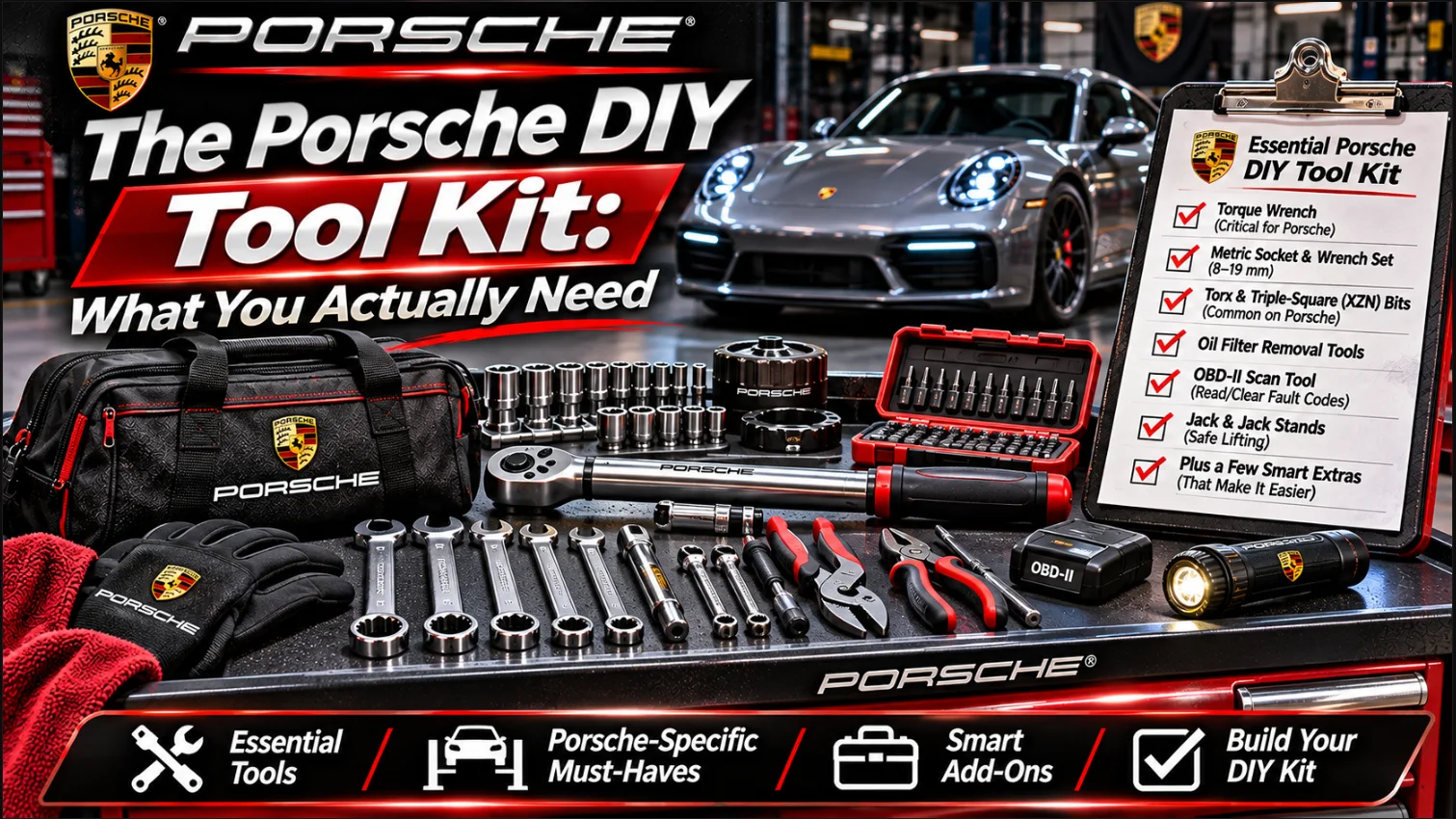
The Porsche DIY Tool Kit: What You Actually Need
You don't need a full shop to work on your Porsche, but you do need the right handful of tools. Here is the core kit, what each piece is for, and which jobs it unlocks.
In this article
- 1. Lifting: a low-profile jack, the right pads and real jack stands
- 2. A torque wrench you trust
- 3. Fasteners: Torx, triple-square and hex
- 4. Model-specific oil service tools
- 5. Battery support: a maintainer and a stable power source
- 6. A multimeter
- 7. A scan tool that matches your car
- 8. Fluid tools
- The kit at a glance
- Where to start
Most Porsche maintenance does not need a lift, a dealer tester or a wall of specialty tools. It needs a short list of the right ones, used properly. The wrong jack in the wrong spot can crush a rocker panel. A cheap socket in a triple-square bolt can strip it. A dead battery halfway through a job can leave you with warning lights and a tow.
This is the kit we would build for an owner starting to do their own work on a 911, Boxster, Cayman, Cayenne, Macan or Panamera. It is organized by what each tool protects: you, the car's structure, its fasteners and its electronics.
One rule runs through all of it: Porsche publishes the procedures and specs for your exact car. Tools let you follow them. They don't replace them.
1. Lifting: a low-profile jack, the right pads and real jack stands
Roughly a third of the jobs on a 911 need the car off the ground, by Pelican Parts' estimate.[1] Lifting is also where DIY work gets dangerous, so it is where to spend first.
Low-profile floor jack. Many Porsches sit low, especially on sport suspension. A jack with a low minimum height and a long reach gets under the car without scraping. Pelican notes that jacking the rear of a 996/997 is easy with a long-reach jack.[1]
Rubber pad or jack-point adapter. Bare steel on a sill or underbody is how cars get dented. Pelican recommends a soft rubber pad between the jack and the car, and describes jack plate tools that attach to the factory points and give the floor jack a wide surface.[1]
Jack stands, used in pairs. Never work under a car held only by a jack. On 996 and 997 cars, Pelican points to the four factory jack support areas as the best place for stands. Those areas have metal cups that locate shop lift pads.[1]
Know your lift points. They differ by model. For the 2009 Cayman (987), the workshop instructions say to lift only at the take-up points shown, never by the engine, transmission or axles, and warn that lifting in the wrong place can damage the door sills and side member panels.[2] Your owner's manual shows the points for your car.
2. A torque wrench you trust
Porsche publishes torque specs for wheel bolts, drain plugs, caliper bolts, suspension fasteners and much more. Aluminum threads, magnesium and plastic housings, and one-time-use bolts don't forgive guessing.
What to get:
- A 3/8-inch drive click wrench for the mid-range fasteners you hit most: drain plugs, filter housings, brake hardware.
- A 1/2-inch drive wrench that covers wheel bolts and larger suspension fasteners.
- A small 1/4-inch drive wrench if you work on interior, plastic or low-torque parts.
Store click wrenches at their lowest setting and have them checked if one has been dropped. Look up the spec for your exact car in the Porsche workshop information or a reputable repair manual every time; we don't publish numbers here because they change by model and year.
3. Fasteners: Torx, triple-square and hex
Porsches use fastener heads that a basic socket set won't cover. Buy good-quality bits, because a rounded fastener turns a one-hour job into a drilling project.
- Torx (and external Torx). Common across modern Porsches. Pelican's Boxster transmission removal lists a Torx socket set alongside a triple-square tool.[5]
- Triple-square (12-point, often sold as XZN). These look similar to Torx but are not. On the 986/987 Boxster, Pelican identifies a triple-square bolt among the transmission mounting fasteners.[5] On the five-speed Boxster gearbox, the drain plug needs a 16 mm triple-square socket.[4]
- Hex (Allen). The same Boxster article lists a 17 mm hex for the five-speed fill plug and a 10 mm hex for both plugs on the six-speed.[4] On 996/997 Carrera engines, the oil drain plug takes an 8 mm hex socket.[6]
4. Model-specific oil service tools
Some Porsche engines use a cartridge oil filter inside a housing rather than a spin-on filter. On 996 and 997 Carreras, the cartridge sits in a plastic housing near the sump, and Pelican says you will typically need the factory filter housing removal tool, or a comparable one, to get it off.[6]
Housing tools differ by engine, so buy the one that matches your car rather than a universal strap wrench that can crack a plastic housing. Add:
- A drain pan sized for your car's oil capacity (check your owner's manual for the figure)
- A funnel and lint-free towels
- New sealing washers and O-rings for the drain plug and housing, from the correct parts list
We cover oil specifications in our Porsche oil guide.
5. Battery support: a maintainer and a stable power source
Modern Porsches are full of modules that don't like low voltage. A smart battery charger/maintainer is one of the most useful tools you can own:
- Storage. A maintainer keeps the battery healthy on a car that sits.
- Long jobs. Doors open, ignition on and fans running drain a battery quickly. Keeping a charger connected protects the battery and the electronics.
- Programming and coding. Porsche treats voltage as critical during software work. Its campaign bulletins require vehicle voltage to stay between 13.5 and 14.5 volts while control units are programmed, warning that failing to do so could damage them.[7] Porsche's US dealer standard pairs a battery charger with every PT4G diagnostic tester, one set per working bay.[8]
A memory saver that feeds the car through the OBD port can help keep some settings during a battery swap. It is a convenience, not a substitute for following your car's battery procedure. Depending on the model, a new battery may also need to be registered with a scan tool; see our battery replacement and registration guide.
6. A multimeter
A scan tool tells you what a module thinks. A multimeter tells you what is actually happening on the wire. A basic auto-ranging digital meter lets you:
- Check resting and charging battery voltage
- Measure parasitic draw when a battery keeps going flat
- Confirm power and ground at a sensor or connector
- Check fuses and continuity before you buy a part
This is the core of "diagnose first." Our low battery and warning lights article shows where a meter fits in that process.
7. A scan tool that matches your car
At minimum, an OBD-II reader or adapter for check engine codes. If you plan to do brakes on a car with an electric parking brake, batteries, or airbag and PDK diagnosis, step up to a Porsche-capable scanner that names your model and those functions. We compare the options in The Best Scan Tools for Porsche Owners.
8. Fluid tools
- Hand pump for gear oil. Pelican recommends a hand-operated pump that attaches to the oil bottle for filling a manual transmission, filling until fluid just starts to run out of the filler hole.[4]
- Fluid extractor. Useful for topping off and some service work.
- Brake bleeding setup. A pressure bleeder or one-way bleeder kit, plus the correct fluid. Some cars also need a scan tool for ABS bleeding procedures.
- Drain pans, funnels and labeled containers. Old fluid needs proper recycling.
The kit at a glance
| Tool | What it's for | Jobs it unlocks |
|---|---|---|
| Low-profile, long-reach floor jack | Getting under a low car without damage | Anything under the car |
| Rubber jack pads or jack-point adapters | Protecting sills and underbody at lift points | Lifting for any job |
| Jack stands (at least two pairs) | Holding the car safely while you work | Brakes, oil service, suspension |
| 3/8 and 1/2 inch torque wrenches | Tightening to Porsche's published specs | Wheels, brakes, drain plugs, suspension |
| Torx, external Torx, triple-square and hex bits | Matching Porsche fastener heads | Drivetrain, brakes, interior, fluids |
| Oil filter housing tool for your engine | Removing cartridge filter housings | Oil and filter service |
| Smart charger/maintainer | Storage and voltage support during work | Long jobs, battery work, coding |
| OBD memory saver | Keeping some settings during battery swaps | Battery replacement |
| Digital multimeter | Measuring voltage, draw, continuity | Electrical diagnosis, battery checks |
| Scan tool | Reading codes, service functions | Diagnosis, EPB, battery registration |
| Gear oil pump and fluid extractor | Filling and topping off fluids | Transmission and differential service |
| Brake bleeding kit | Removing air from the brake system | Brake fluid service, pad and caliper jobs |
Where to start
If you are building this from zero, buy in this order: lifting gear and stands, torque wrenches, a good bit set, a battery maintainer, a multimeter, then a scan tool sized to the jobs you will really do. Add model-specific tools like a filter housing socket when you take on that job.
Before any job, find the procedure and specs for your exact car, and check your fasteners and lift points before you start rather than halfway through. If you want a list of the parts, fluids and service intervals for your specific car in one place, TekGarage decodes your VIN and builds it for you, and our diagnostic help is there when a job stops making sense.
Sources
- Jacking Up Your Porsche 996/997 CarreraApplies to 996 and 997 Carrera, Turbo, GT2 and GT3. Original publication date not shown.
- Cayman (987) F6-2.9L (2009): Vehicle Lifting, Service and RepairThird-party reproduction of workshop lifting instructions for the 2009 Cayman (987). Undated.
- Panamera S (970) V8-4.8L: Vehicle Lifting, Service and RepairThird-party reproduction of workshop lifting instructions for the first-generation Panamera (970). Undated.
- Porsche Boxster Differential / Manual Transmission Fluid Change - 986 / 987 (1997-08)Original publication date not shown.
- Porsche Boxster Transmission Removal - 986 / 987 (1997-08)Original publication date not shown.
- Porsche 911 Carrera Oil Change - 996 (1998-2005) - 997 (2005-2012)Original publication date not shown.
- WRV3 - Update to Software Network VR11 (Workshop Campaign), TaycanDate is the bulletin's second release.
- Porsche Center Standards for Diagnostic Testers (PT4G) and associated Equipment, SPTL 2314
Diagnose first. Then turn the bolt.
Not sure which tool you need?
Tell us your car and the job. We'll point you at the right equipment, not the most expensive.