Which Oil Does Your Porsche Need? Porsche A40, C30 and C20 Explained
Porsche assigns each engine an oil approval, not just a viscosity. Here's what A40, C40, C30 and C20 mean, which engines Porsche's own bulletins assign them to, and how to buy the right oil.
In this article
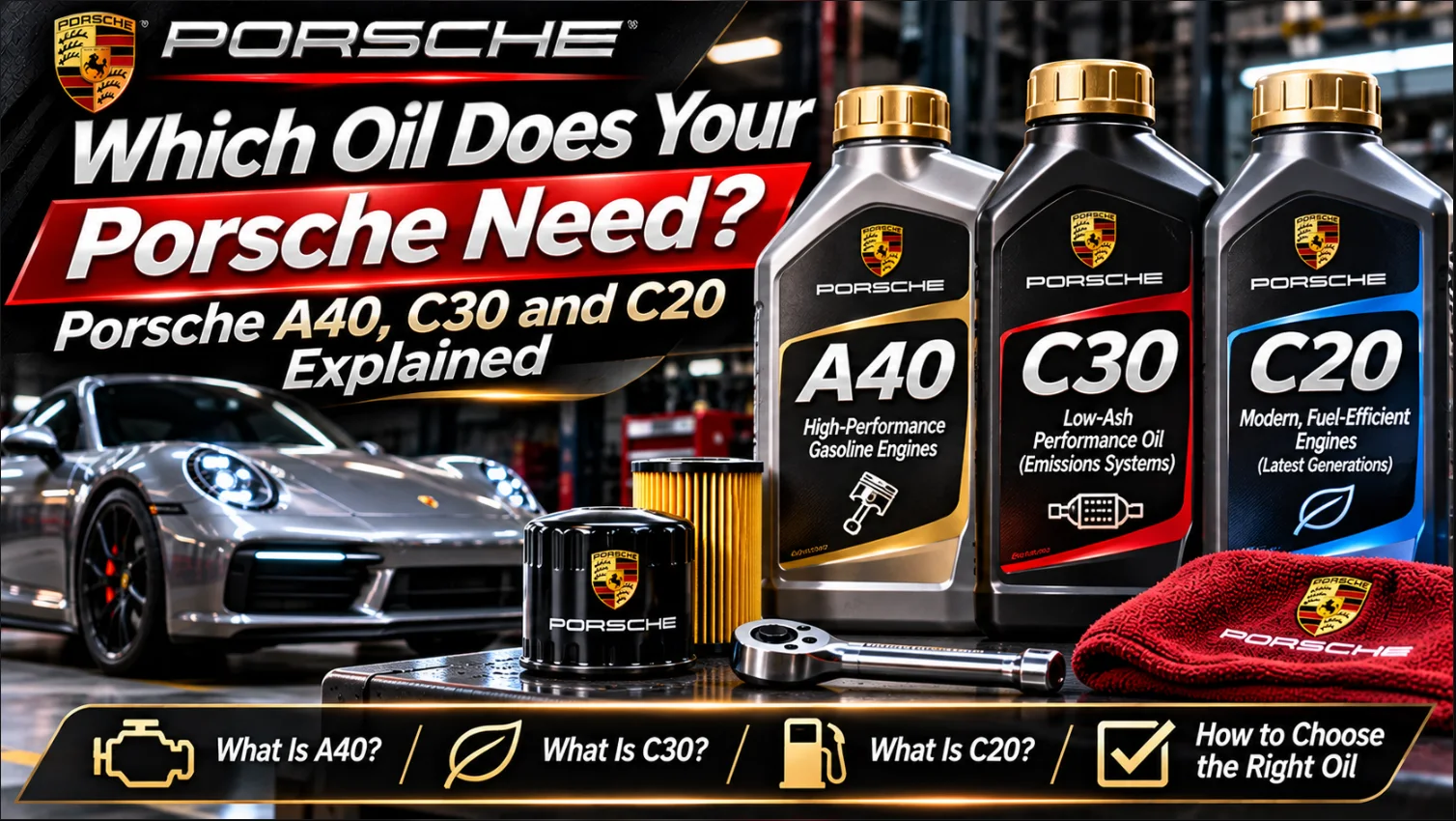
Walk into any parts store and you'll find a wall of 0W-40 and 5W-40. Plenty of it will fit in your Porsche. Much less of it is what Porsche actually specifies, because Porsche doesn't specify oil by viscosity alone. It specifies an approval: A40, C40, C30 or C20, and on some cars C40 GT.
Those codes trip people up. They look like viscosity grades, but they aren't. A bottle can say 0W-40 and still not carry the approval your engine calls for. And the right approval for your car can depend on the engine, the model year, whether there's a particulate filter, and even which country the car was sold in.
This guide explains what the approvals are, which engines Porsche assigns them to according to its own technical bulletins, why the approval matters, and how to make sure the oil you buy is the right one.
What a Porsche oil approval actually is
A Porsche approval is a Porsche specification an oil has to meet and be listed against. Porsche's technical bulletins say plainly that only oils approved by Porsche, from the current status of the approval lists, are to be used for the vehicle types listed.[1]
The approval and the viscosity are two different things:
- Viscosity (0W-40, 5W-30 and so on) describes how thick the oil is cold and hot. Porsche's bulletin explains the SAE system: the number before the W describes low-temperature viscosity, and the second number describes viscosity at high temperature.[1]
- The approval says the oil meets Porsche's specification for a given engine family. Each approval maps to one or more permitted viscosities.
So "the right viscosity" is necessary but not enough. You need the right approval, in one of the viscosities Porsche lists for it.
A40, C40, C40 GT, C30 and C20 at a glance
Porsche's bulletin includes a legend that ties each approval to its viscosity class.[1] The engine examples below come from the same bulletin's allocation tables for MY1997 to MY2020 and from Porsche's MY2027 allocation bulletin. They reflect the country group that includes the USA ("Group I").[1] [2]
| Approval | Viscosities Porsche lists | Examples of engines Porsche assigns it to (US / Group I) |
|---|---|---|
| A40 | 0W-40, 5W-40 or 5W-50 | Boxster/Cayman 986, 987, 981; 911 996 and 997; 991.1 Carrera and Turbo; Macan V6 up to MY2018 (Macan S, GTS, Turbo); Cayenne 9PA/92A S, GTS, Turbo and Turbo S; Panamera 970 non-hybrid |
| C40 | 0W-40 or 5W-40 (MY2027 list: 0W-40) | 718 Boxster/Cayman (982) MY17 to MY20; 992 MY20; V8 Cayenne 9YA and Panamera 971 (GTS, Turbo, Turbo S E-Hybrid) MY18 to MY20; MY2027 911 Carrera family and V8 Cayenne and Panamera |
| C40 GT | 0W-40 | MY2027 911 GT3 (4.0-liter naturally aspirated); also listed alongside A40 for 991.1 GT3 and 911 R |
| C30 | 0W-30 or 5W-30 (MY2027 list: 0W-30) | Macan 2.0 four-cylinder up to MY2018; Cayenne diesels up to MY2016; Cayenne 92A and Panamera 970 hybrids; Panamera 971 4 and 4S, Cayenne 9YA S, and Macan GTS/Turbo MY19 to MY20 (EA839 LK3 engines); MY2027 Panamera V6 |
| C20 | 0W-20 | Panamera 971 base and Cayenne 9YA base (EA839 LK2 engine) MY18 to MY20; Macan 2.0 and Macan S MY19 to MY20; MY2027 Cayenne with the EA839 LK2 V6 |
That table is a summary, not a substitute for the bulletin. The bulletin rows split by engine code, by particulate filter (DPF/PPF) yes or no, and by country group. Some 991.2 rows, for example, list a different approval for cars with a gasoline particulate filter than for cars without one.[1] Find your exact row before you buy.
Market and model-year differences
Two details in Porsche's bulletins catch people out.
Country groups. Porsche splits markets into Group I and Group II. The USA, Canada, most of Europe, Australia, Japan and China are among the Group I countries; Group II includes much of the Middle East, Central and South America and Southeast Asia.[1] Some engines get a different approval depending on the group. For example, the 971 Panamera base model with the EA839 LK2 V6 is assigned C20 in Group I, while the Group II table lists A40 for cars without a particulate filter.[1] If you imported your car, or you're reading a forum thread from another region, this matters.
Model year. Porsche's MY2027 bulletin states that from MY2021, only 0W oils may be used for all vehicles.[2] So a 5W-40 that's fine on a 997 is not the answer for a 2021-or-later car, even if it carries an approval code you recognize. The same bulletin says cars up to MY2020 use the separate allocation list written for them, and later model years use their own lists.[2]
Classic cars. For air-cooled boxer engines, Porsche recommends special engine oils that aren't on these allocation lists.[1] Don't apply this table to a 964 or 993.
Why the approval matters
Two reasons: warranty paper trail and the engine itself.
On the warranty side, Porsche's bulletin is the instruction Porsche technicians work from, and it says only approved oils are to be used.[1] If your car is under factory or certified pre-owned warranty, using an approved oil and keeping receipts that show it is the simplest way to avoid an argument later. This isn't legal or warranty advice; ask your Porsche Center how your coverage handles oil service done elsewhere.
On the engineering side, look at how Porsche structures the allocation. The approvals split not just by engine but by whether the car has a particulate filter.[1] That tells you the approval covers oil chemistry that affects more than the bearings, including compatibility with exhaust aftertreatment. A viscosity grade on its own tells you nothing about that. The approval is how you know an oil was tested for the job.
Mixing and topping up is simpler than people fear. Porsche says all approved oils can be mixed provided they carry the same Porsche specification, so you don't need to flush the engine when switching brands. It still recommends topping up with the same brand and type between changes where possible.[1]
How often to change it
For gasoline and hybrid Porsches in the US, the commonly published interval is every 10,000 miles or once a year, whichever comes first.[3] Porsche Cars North America's prepaid maintenance plan starts with a 1 year/10,000 mile first service for combustion cars.[4] A dealer-posted Macan checklist lists the same oil service interval.[5]
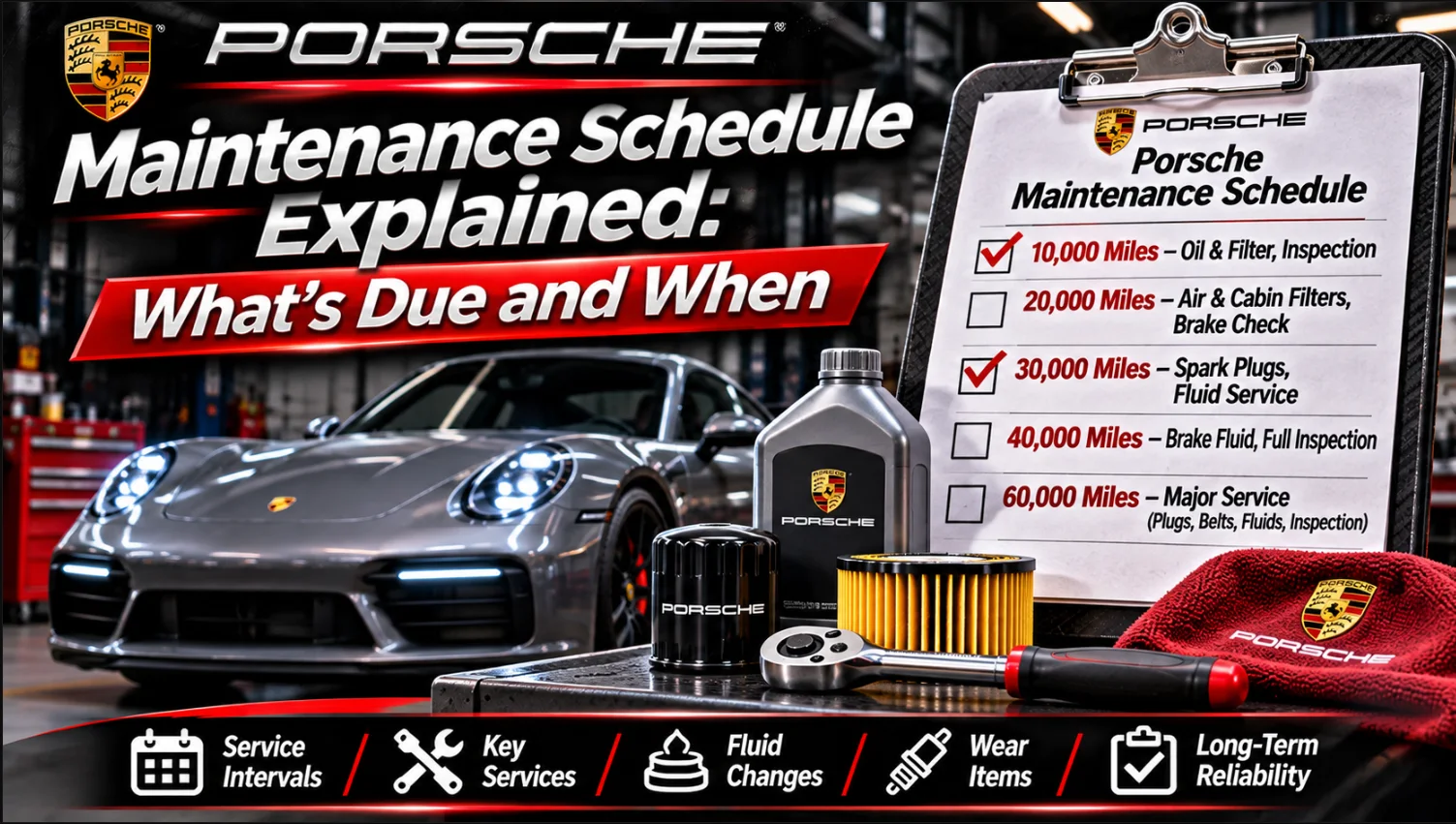
The time limit matters as much as the miles. Oil ages even when the car sits, which is why a car driven 3,000 miles a year still needs its annual oil service.[3] Your maintenance booklet has the exact interval for your model, including GT cars, which can differ. Track use and very hot climates are reasons to change it sooner, not later. Our Porsche maintenance schedule guide covers how the oil service fits with the other intervals.
How to buy the right oil
A quick process that works for any Porsche:
- Identify your engine, not just your model. Model year, model, and engine code. The VIN and the engine code tell you which row of the bulletin you're in.
- Check particulate filter fitment. Newer cars in some markets have a gasoline particulate filter, and the bulletin treats those cars separately.
- Find your approval in Porsche's allocation list for your model year.
- Buy an oil that lists that exact approval on the label or in the oil maker's documentation, in a viscosity Porsche lists for that approval.
- Check capacity in the workshop information or owner's manual. We don't list fill quantities here because they vary by engine; overfilling and underfilling both cause problems.
Safety note: support the car on jack stands or a lift, never on the jack alone. Drained oil and the filter housing can be hot enough to burn, and some cars need their underbody panels removed first. Dispose of used oil at a recycling point.
Doing the oil service yourself
An oil service is one of the best DIY jobs on a modern Porsche, as long as you have the right oil, the right filter and the fill quantity for your engine. If you've got a Macan, our walk-through video, Porsche Macan Oil Change Service, shows the job start to finish. On many newer Porsches you'll also want a scan tool that can reset the service indicator; our guide to Porsche scan tools covers the options.
If you'd rather not dig through bulletins, TekGarage decodes the engine from your VIN and lists the filters and fluids for that engine with correct quantities, so you know what to buy before you start.
The takeaway is simple. Viscosity tells you how thick the oil is. The Porsche approval tells you whether it's the right oil. Match the approval to your engine row, use a viscosity Porsche lists for it, and change it on time.
Sources
- Allocation of Approved Engine Oils Until MY 2020 (12/25), Technical Bulletin 1701Covers Porsche series vehicles MY1997 to MY2020. Replaces the bulletin dated May 9, 2025. Allocation varies by country group and particulate filter fitment.
- Allocation of Approved Engine Oils MY 2027 (13/26), Technical Bulletin 1701Covers all Porsche series vehicles for MY2027, worldwide validity.
- Porsche Maintenance ScheduleDealer's general guide. Publication date not shown.
- Porsche Scheduled Maintenance Plan OptionsFooter reads 'Last updated: 4/6/2026'.
- Macan – Intermediate Maintenance 40/80/120/160kDealer-posted Macan checklist; model years not stated. Publication date not shown.
Diagnose first. Then turn the bolt.
Track every service in one place
TekGarage keeps your Porsche's service history, specs and reminders together.