Porsche Pre-Purchase Inspection: What to Check Before You Buy
A practical guide to inspecting a used Porsche before you buy: what a specialist should check, how to read the overrev report, and what Porsche Approved CPO does and doesn't change.
In this article
- Why a Porsche specialist, not a general shop
- Paperwork and service history
- Scan every module, not just the engine
- The overrev report on 986, 996, 987 and 997
- Compression, leakdown and bore scoping
- Model-specific checks
- Cosmetic and accident clues
- Porsche Approved CPO vs a private sale
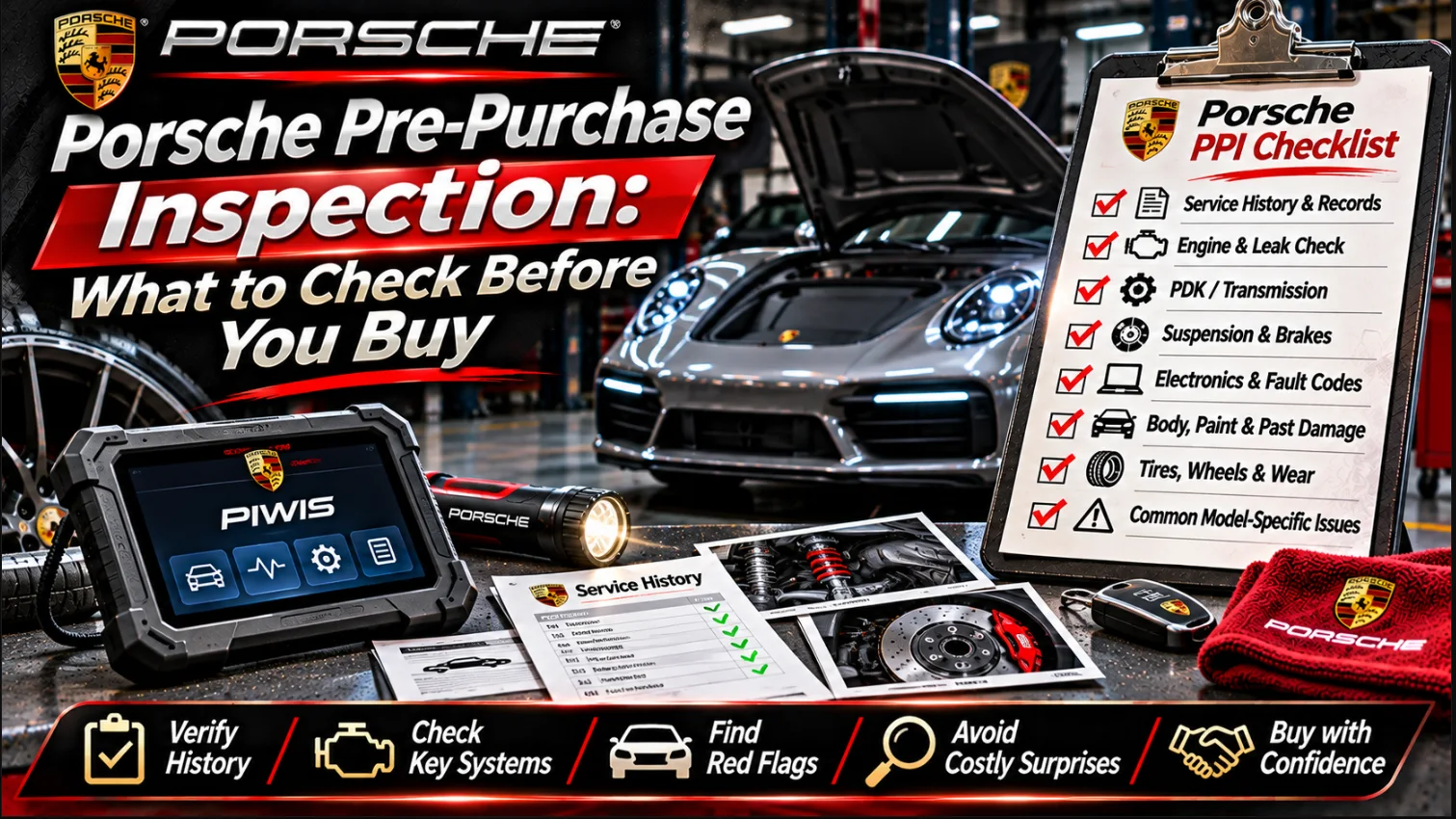
- The pre-purchase checklist
- Before you sign
A used Porsche can be one of the best-value performance cars you can buy, or the most expensive mistake in your garage. The difference is rarely visible in photos or on a test drive. It is in the service history, in the engine control unit's memory, and inside the cylinders.
That is what a pre-purchase inspection (PPI) is for. Done properly, by someone who works on these specific cars, it turns a gamble into a decision with known costs. Hagerty calls a thorough PPI by a 996 expert "critical" for ruling out bore scoring[4] and says one by a shop familiar with water-cooled 911s is a must on a 997[5].
This guide walks through what a good Porsche PPI covers, in the order we would do it, and what to make of the findings.
Why a Porsche specialist, not a general shop
A general shop can check brakes, tires and fluid leaks. What it usually cannot do is read Porsche-specific data, and that data matters more on these cars than on most.
- The engine control unit on 986, 996, 987 and 997 models logs overspeed events, and reading that log properly takes a Porsche-capable tool[1].
- Model-specific checks change by generation. Bore-scoping an M96/M97 for scoring is done from the sump, not through the spark plug holes, according to LN Engineering[3].
- A specialist knows what normal looks like. A small seep or a stored fault can be routine on one car and a red flag on another.
Pick the inspector yourself. A shop the seller suggests may be fine, but you want someone who works for you.
Paperwork and service history
Start before anyone touches the car. Ask for:
- Service records, ideally with dates and mileage that line up. Gaps are not automatically bad, but they are questions.
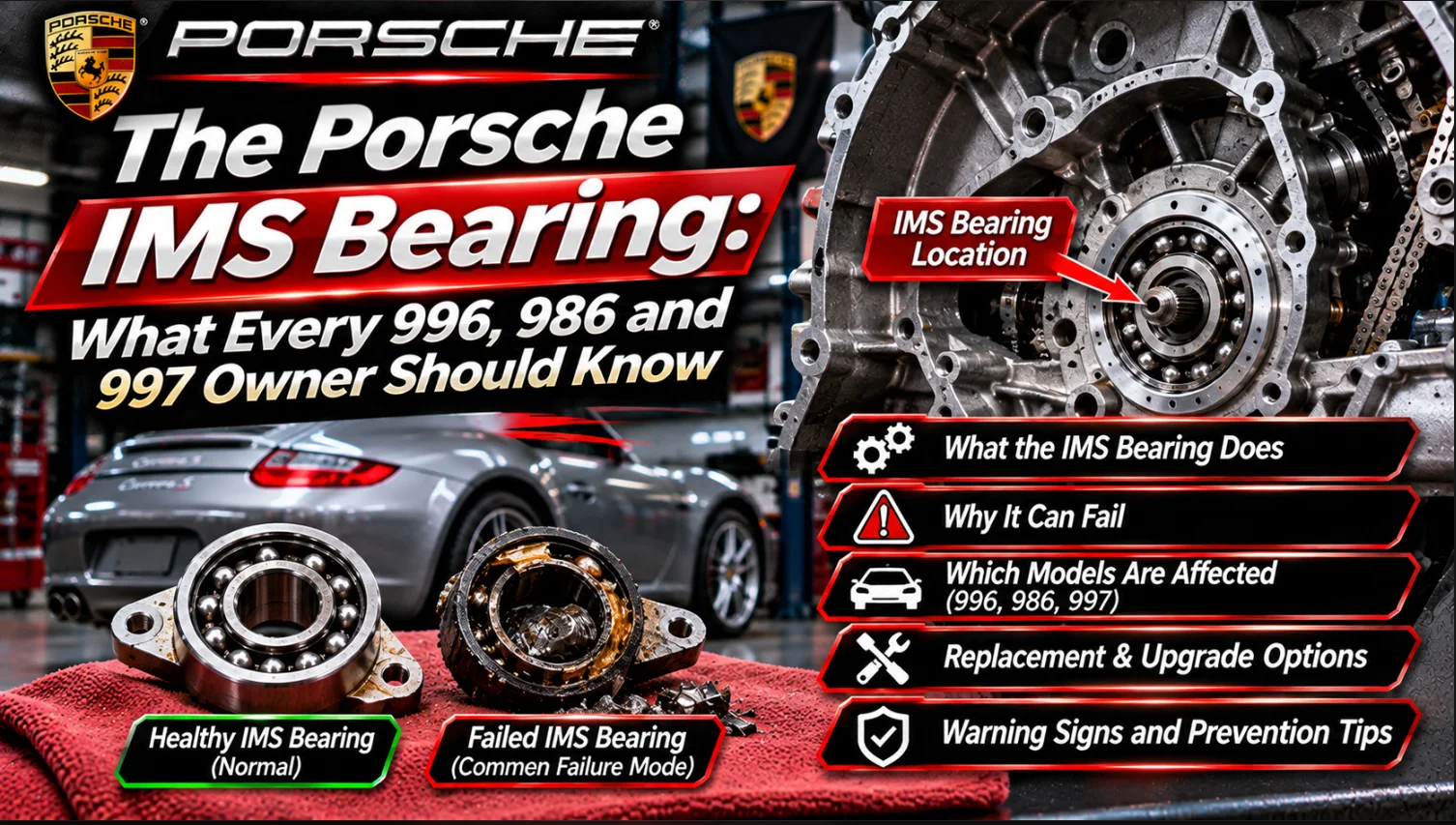
- Engine number. On 996, 986, 987 and 997 cars, this tells you which IMS bearing the engine left the factory with, and whether it is a replacement engine[4]. See our IMS bearing guide.
- Receipts for big jobs: IMS replacement, clutch, rear main seal, water pump, PDK service on later cars.
- Recall status. Run the VIN through Porsche or NHTSA's recall lookup at nhtsa.gov/recalls. Open recalls are fixed free, but you want to know.
- Title and history report, for accident, flood or salvage brands.
Mileage claims should match the paperwork and the wear on pedals, seat bolsters and the steering wheel.
Scan every module, not just the engine
A basic OBD-II reader shows emissions-related engine codes and little else. A Porsche-capable tool reads every control unit: engine, transmission, ABS/PSM, airbags, body electronics, and so on. Stored and intermittent faults in those modules tell you what the car has been doing between services. Our scan tool guide covers the options, and what is PIWIS explains Porsche's own system.
Watch for signs that codes were recently cleared. Emissions readiness monitors that have not completed are a common sign that the fault memory was wiped shortly before the sale. That does not prove anything bad, but it means the scan is telling you less than it should.
The overrev report on 986, 996, 987 and 997
This is the single most important check on manual-transmission cars from these generations.
Porsche's own technical bulletin explains that the DME stores overspeed events, recording the number of ignition attempts in each rev range and the hour-meter reading at the last event[1]. The usual cause is a missed downshift on a manual car, where the car's momentum spins the engine past the limiter. Porsche also lists tuning as a cause[1].
The bulletin covers the 986/996 (model years 1997 to 2004), the 987/997 from 2005 to 2008, and 987/997 cars from 2009 on, each with its own thresholds[1]. For the first two groups, Porsche's ranges are:
| Range | 986 / 996 | 987 / 997 (2005–2008) | Porsche's assessment |
|---|---|---|---|
| 1 | 7,200–7,900 rpm | 7,200–7,500 rpm | Damage possible |
| 2 | Above 7,900 rpm | 7,500–7,700 rpm | 986/996: damage probable. 987/997: possible |
| 3 | n/a | 7,700–7,900 rpm | Damage possible |
| 4 | n/a | 7,900–8,400 rpm | Damage probable |
| 5 | n/a | 8,400–9,500 rpm | Damage very probable |
| 6 | n/a | Above 9,500 rpm | Damage has generally occurred |
How to read it:
- Look at the range, the count and the timing together. Porsche says that if damage is present and the last overspeed was less than 50 operating hours before the current hour-meter reading, there is a high probability the overspeed caused it. It also says damage much later can't be ruled out[1].
- Don't panic over an odd entry. Porsche notes that because events are logged at set intervals, an entry can appear in a higher range with nothing in the lower one[1].
- Higher ranges mean a deeper inspection. For range 2 on 986/996 and ranges 4 to 6 on 987/997, Porsche tells dealers to call its technical hotline before granting a pre-owned warranty[1]. LN Engineering's guide, which describes Porsche's policy as of 2018, says ranges 3 and 4 then called for compression tests and/or oil checks[2].
- Turbo and GT3 use different thresholds. LN's guide lists separate rpm tables for those cars[2], so make sure your inspector applies the right one.
LN's guide also says Porsche dealers were advised to disregard overrev data on PDK and Tiptronic cars for warranty purposes[2]. The data is most meaningful on manuals.
Compression, leakdown and bore scoping
On engines with known cylinder issues, the inside of the engine matters more than how it sounds on a test drive.
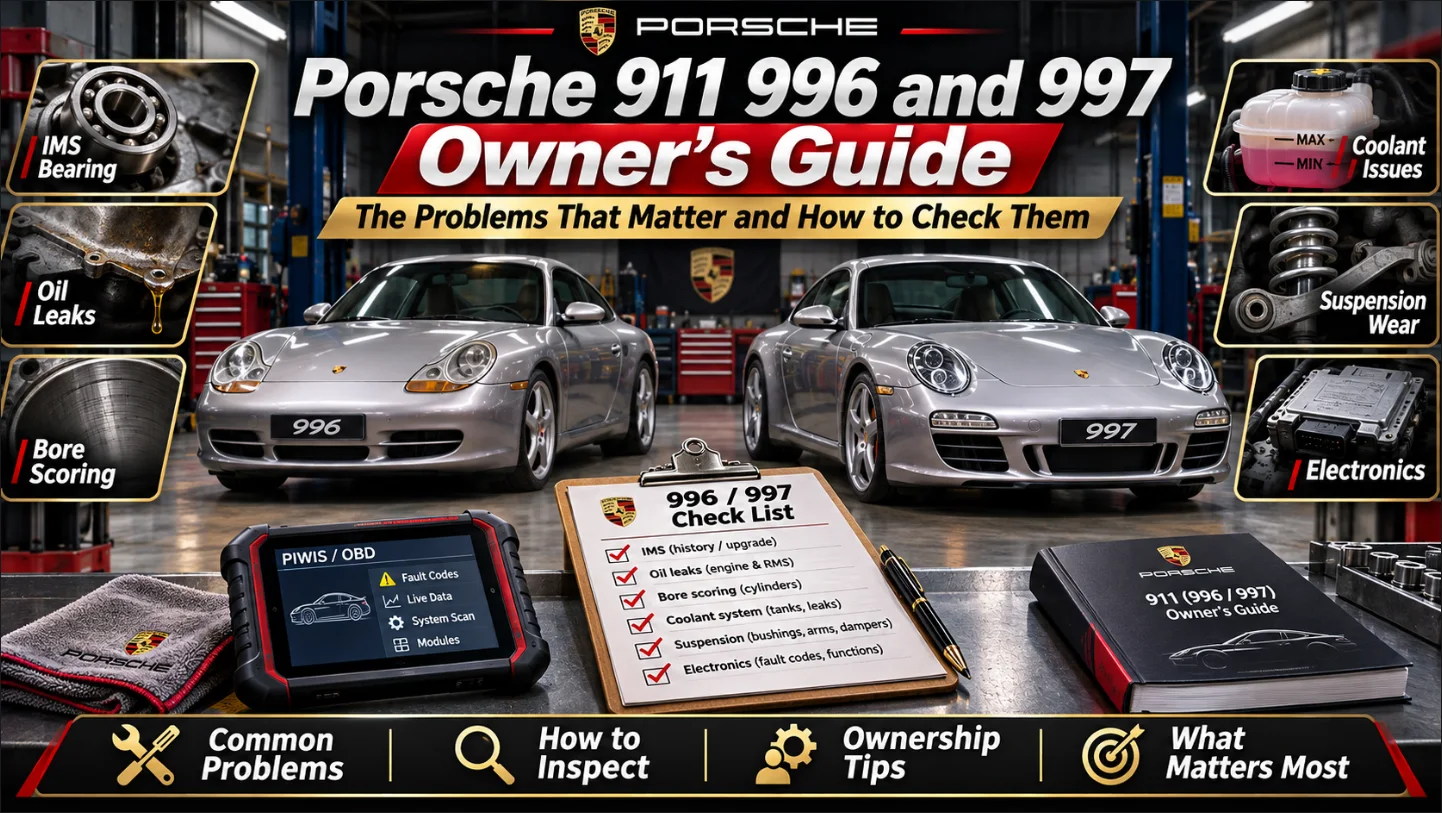
- Bore scoring (M96/M97). Hagerty describes it as deep scratches in the cylinder lining that raise oil consumption and eventually lead to failure. Signs include a ticking at idle and sootier exhaust, often from one pipe. It is more common on 3.6-liter 996s than on 3.4s[4], and anecdotally more common on 3.8-liter 997s[5]. Hagerty recommends bore-scoping and oil analysis[5], and LN says to scope from the sump[3].
- Compression and leakdown tests give numbers you can compare cylinder to cylinder. They are the natural follow-up when the overrev log or the scope raises questions. Per LN's guide, Porsche's own pre-owned warranty policy called for compression tests and/or oil checks on cars with range 3 or 4 entries[2].
Not every PPI includes scoping by default, and it adds time. On an M96/M97 car, we would pay for it.
Model-specific checks
A good inspector adjusts the checklist to the car:
- 986, 996, 987.1, 997.1 (M96/M97): identify the IMS bearing and any documented replacement, check for bore scoring, look at the rear main seal area. See the IMS bearing guide.
- 996/997 Turbo and GT3: Hagerty notes the factory-bonded coolant pipes can let go under hard use, and the usual fix is pinning or welding them[4].
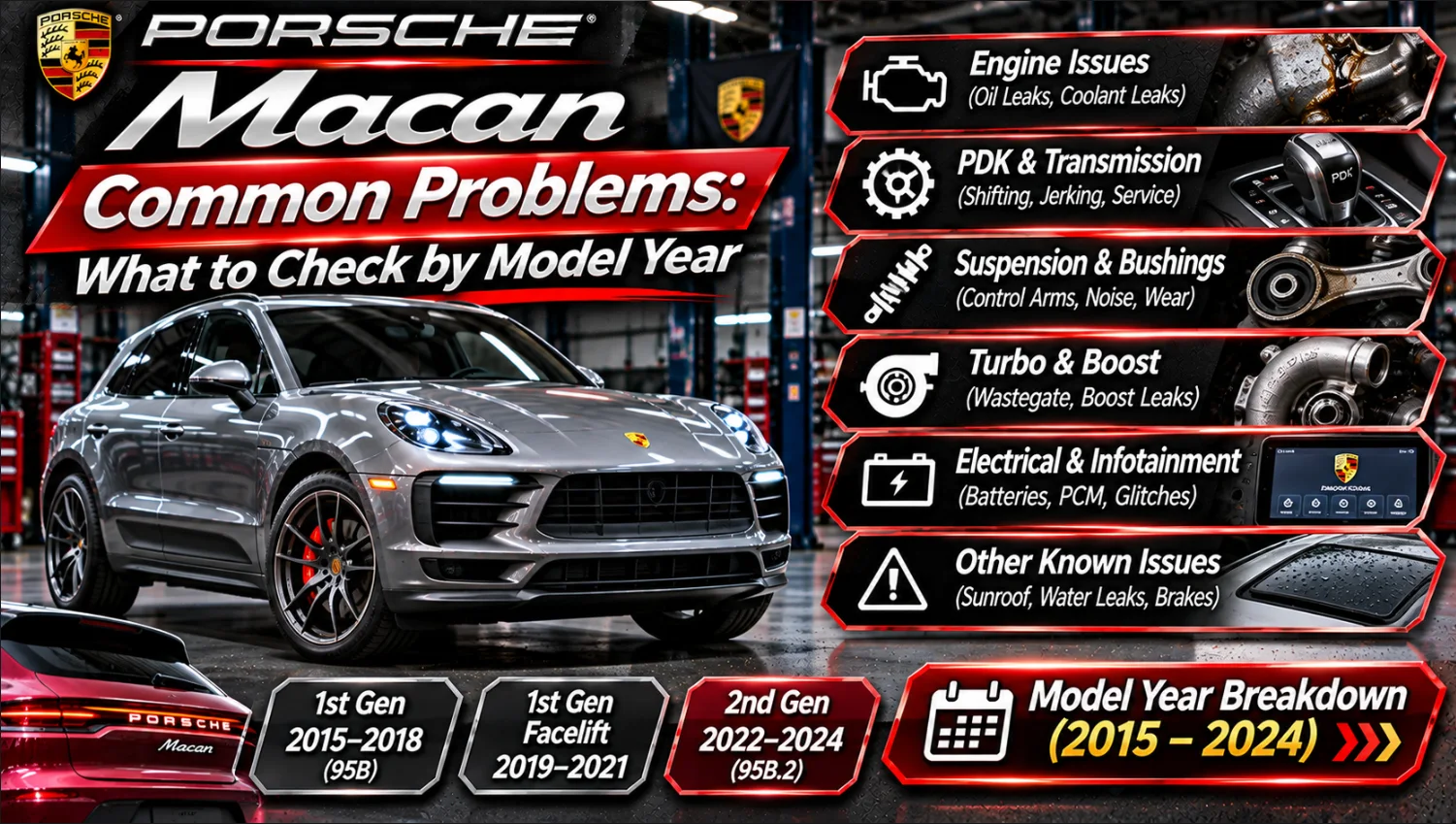
- Macan (95B): check open recalls and how the car feels pulling away from a stop. Porsche extended the transfer gear warranty on 2014–2018 Macans to seven years from delivery[8], and most of those cars are now past it. See our Macan problems guide.
- PDK cars: ask for service records. Our PDK service guide explains what to look for.
Cosmetic and accident clues
Paint and panels tell the car's history:
- A paint thickness gauge quickly finds refinished panels. A respray is not a dealbreaker; hidden structural repair is.
- Uneven panel gaps, overspray on rubber seals or under-hood labels, and mismatched headlight lenses all suggest past repairs.
- Look at bolt heads on fenders, the hood and the front bumper carrier for wrench marks.
- Underneath: fresh undercoating in one area, kinked pinch welds, or new suspension parts on one corner only are worth questions.
Porsche Approved CPO vs a private sale
A Porsche Approved Certified Pre-Owned car changes the risk.
According to Porsche USA, the CPO limited warranty is 2 years with unlimited miles and begins when the new-vehicle limited warranty (4 years or 50,000 miles) runs out[6]. A Porsche dealer's program page adds that if the new-car warranty has already expired, coverage runs from the date of sale. The same page says cars qualify within the current and 13 previous model years and under 124,000 miles, after a 111-point inspection with work done by Porsche-trained technicians using genuine parts[7]. Program terms change, so confirm them in writing with the selling dealer. Nothing here is legal or warranty advice.
| Porsche Approved CPO | Private or independent-dealer sale | |
|---|---|---|
| Warranty | 2 years, unlimited miles, per Porsche USA | Usually none, unless purchased separately |
| Inspection | Dealer's 111-point CPO inspection | Only what you arrange |
| Price | Usually higher | Usually lower |
| Your PPI | Still worth reading the scan and overrev log | Essential |
CPO lowers your risk, but it doesn't make your own inspection pointless. Ask for the completed checklist and a copy of the scan.
The pre-purchase checklist
| Check | How | What should worry you |
|---|---|---|
| Records | Read every invoice, match mileage | Missing years, no big-job receipts |
| Engine number | Compare to title year and records | Undisclosed replacement engine |
| Recalls | VIN lookup | Open recalls the seller can't explain |
| Full module scan | Porsche-capable tool | Many stored faults, recent clearing |
| Overrev log (manual 986/996/987/997) | DME vehicle analysis log | Higher ranges, recent hour-meter entries |
| Bore scope (M96/M97) | From the sump | Scoring on any cylinder |
| Compression/leakdown | Cylinder-to-cylinder comparison | One cylinder off the others |
| Leaks | Lift inspection | Rear main seal, coolant, transfer case |
| Body | Paint gauge, gaps, bolts | Structural repair, flood signs |
| Test drive | Cold start, full warm-up, all gears | Rattles, slipping, warning lights |
Before you sign
Treat the PPI report as a price list, not a pass/fail. Most findings either lower the price or tell you what to budget for in the first year. A few should send you home: evidence of serious overspeed, scored cylinders, unexplained engine swaps, or structural damage.
TekGarage's pre-purchase inspection mode is built for this visit. With an OBD adapter it reads and clears trouble codes with Porsche-specific explanations, checks emissions readiness and tune status, and shows recalls and known failure points for the VIN, which gives you a structured first look before the specialist's report. See TekGarage, or get diagnostic help if a finding needs a second opinion.
Safety note: if you crawl under a car during an inspection, only do it on a lift or on properly rated jack stands on solid ground, never on a jack alone.
Sources
- Technical Information 0335: Vehicle Analysis Log: Evaluating Over-Revving Events (Boxster/Cayman/Carrera)Porsche bulletin 6/09, reissued April 10, 2024; hosted in NHTSA's technical service bulletin library.
- Porsche Ignition Over Rev Ranges GuideKnowledge-base article stating its information is accurate as of 2018; last updated July 29, 2025.
- IMS Pre-Qualification
- Your Handy Porsche 996 Buyer's Guide
- Your Handy 2005–12 Porsche 911 (997) Buyer's Guide
- Porsche Warranty
- Certified Pre-Owned ProgramDealer page on porsche.com describing Porsche Approved eligibility and the 111-point inspection; confirm current terms with the selling dealer.
- Technical Information 83/20: Extended Warranty for Transfer Gear (Hang-On), Macan (95B)
Diagnose first. Then turn the bolt.
Buying a Porsche?
Get a second opinion on the car, the history and the scan data before you sign.