The Porsche IMS Bearing: What Every 996, 986 and 997 Owner Should Know
Which 986, 996, 987 and 997 engines carry an intermediate shaft bearing, what the documented failure figures actually say, and how to decide whether and when to replace it.
In this article
Few parts have shaped a car's reputation like the intermediate shaft bearing has shaped the 996 and the first Boxster. Mention one of these cars and somebody brings up the IMS. Some of that is earned. A failed bearing usually means a destroyed engine. Some of it is noise, repeated by people who have never looked at which bearing a given engine actually has.
The useful version of the story is narrower and more practical. Only certain engines have the part. Within those, the risk depends heavily on which of three factory bearing designs is fitted, and the model year alone does not always tell you. The documented failure figures are real but often quoted without the context that comes with them.
This guide covers what the bearing does, which cars have it, what the class action settlement actually said, the warning signs (and their limits), and when replacement makes sense.
What the IMS bearing does
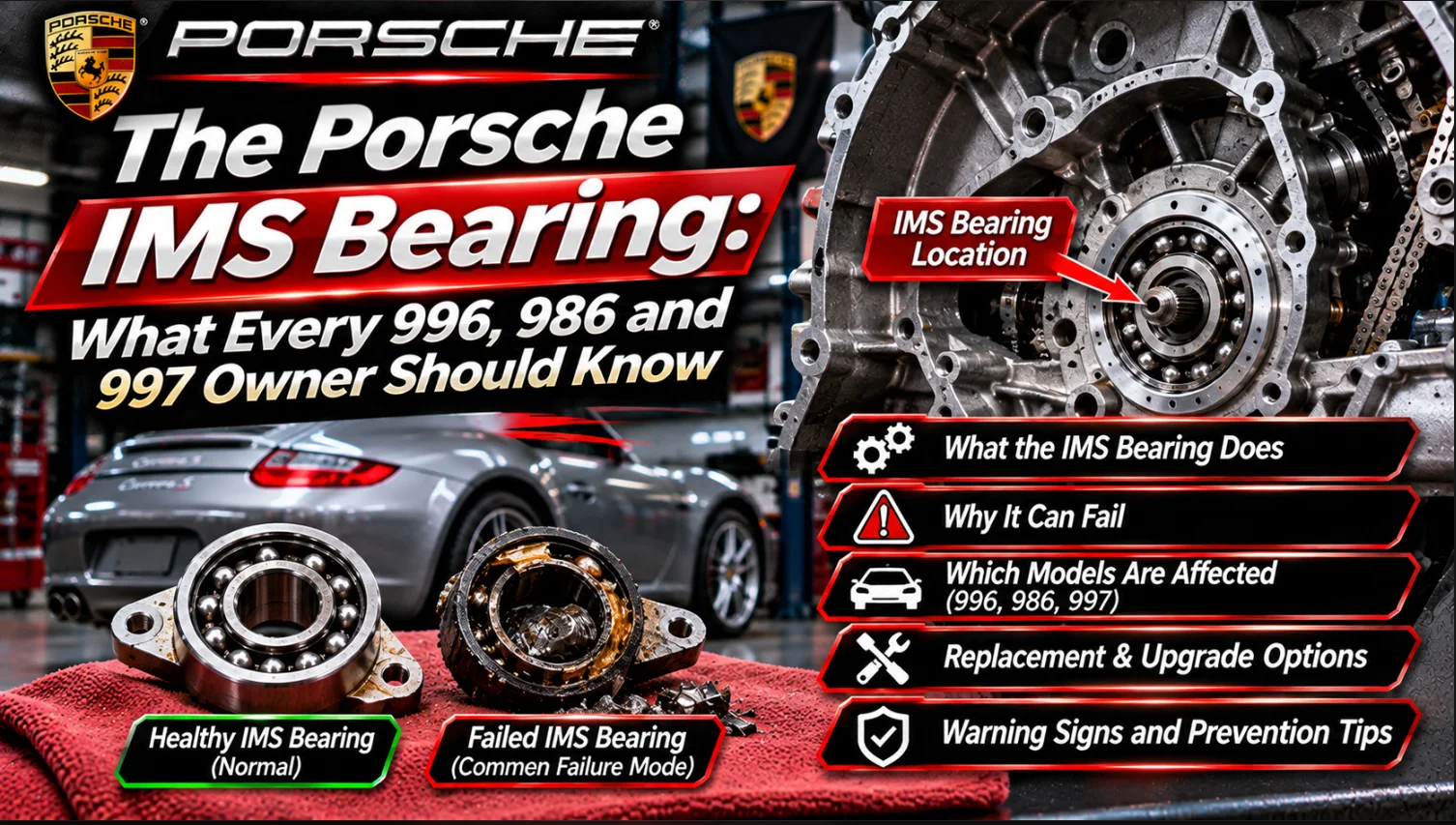
The M96 and M97 flat-sixes used in the 986 Boxster, 996 Carrera, and the 987.1 Boxster/Cayman and 997.1 Carrera do not drive the camshafts straight off the crankshaft. The crank drives an intermediate shaft, and the intermediate shaft drives the timing chains to the cams. The rear end of that shaft rides on a sealed ball bearing. That is the IMS bearing.
When the bearing fails, the shaft can lose its location and the engine loses cam timing. LN Engineering, which makes replacement kits, describes the result as loss of camshaft timing, valve-to-piston contact and severe internal damage[1]. Hagerty puts the typical overhaul bill after a failure at $20,000 to $30,000 for a 996, which on some cars is more than the car is worth[7].
The sealed design is the core complaint. The bearing sits in engine oil but a grease seal keeps that oil from properly lubricating and cooling it,[1], and LN notes Porsche never supplied a service interval for it[4].
Which cars have it, and which bearing
These cars do not have the problem bearing:
- 996 and 997 Turbo, GT2 and GT3. They use Mezger-derived engines whose intermediate shaft runs in pressure-fed plain bearings[1]. The Eisen settlement class also excluded them[5].
- 2009-on Boxster, Cayman and 911 (987.2, 997.2) with the 9A1 engine. That engine drives the cams directly and has no intermediate shaft at all[1][8].
For the M96/M97 cars, three factory bearings were used. This table follows LN Engineering's breakdown[1][2]:
| Model years | Cars | Factory bearing | Serviceable without engine teardown? |
|---|---|---|---|
| 1997–1999 | 986 Boxster, 1999 996 | Dual row | Yes |
| 2000–2001 | 986, 996 | Dual row or single row | Yes |
| 2002–2004 | 986, 996 | Single row | Yes |
| 2005 | 996, 997, 987 | Single row or the later larger bearing | Depends on the engine |
| 2006–2008 | 987.1 Boxster/Cayman, 997.1 Carrera | Larger single row | No |
Sources disagree slightly on the changeover dates. Hagerty's 996 guide gives the double row as 1999–2000 and the single row as 2001–2004, and says the cut-off didn't always follow model year[7]. Its 997 guide says the first half of 2005 used the single row and mid-2005 through 2008 the larger bearing[8]. The practical point is the same everywhere: check the engine, not the title.
How to tell on a 2000–2001 car: LN says a single row flange measures 19.27 mm deep and a dual row flange 13.34 mm. The 2006–2008 bearing is identifiable by its 22 mm center nut[2].
What the Eisen settlement actually said
The legal record is the one solid public data point on failures, so it is worth reading carefully.
The case was Eisen v. Porsche Cars North America, in the U.S. District Court for the Central District of California, No. 11-cv-9405. It covered most 2001–2005 Boxsters and 911s built with an IMS between May 4, 2001 and February 20, 2005, excluding the Turbo, GT2 and GT3[5]. Sports Car Market counted the class at 57,929 cars[6].
- Reimbursement of out-of-pocket repair costs for IMS failures, plus up to $200 for documented towing or rental.
- For future failures, coverage up to 10 years from the in-service date or 130,000 miles, whichever came first.
- A sliding scale. Per Sports Car Market, cars bought new got 100% up to 50,000 miles, stepping down 10% per 10,000 miles to 40% between 100,000 and 130,000 miles. Porsche CPO cars got 100% to 100,000 miles, then 25%. Other used cars got 25%.
- Nothing for preventive replacement. You had to have a failure.
- Past claims had to be filed by October 15, 2013.
Every class car is now well past the 10-year limit, so the settlement no longer pays anything on these cars. LN also notes the IMS was never the subject of a recall[1].
How often do they actually fail?
This is where the internet gets loose with numbers, so here are the figures with their sources attached.
- LN Engineering, citing figures made public through the Eisen settlement, says about 1% of original dual row bearings and 8% of original single row bearings failed under warranty[4]. LN's own guide adds that these warranty-period figures should not be read as lifetime failure rates[1].
- The plaintiffs' attorney, quoted by Sports Car Market, put the failure rate at around 10% and said Porsche had repaired about 3,100 cars[6].
- Hagerty's 997 guide says the larger 2006–2008 bearing fails quite rarely, while noting the author suspects more single row bearings have failed over time than the warranty figure implies[8].
Read together: the single row bearing is the one to worry about, the dual row is better but not immune, and the late bearing is the most robust of the three. Most cars, even single row cars, have not failed. LN also says failures have historically been associated with cars that sit for long periods or see mostly short trips[1].
Warning signs, and why they are not enough
This is the hard part. LN says the dual row bearing can shed visible ferrous debris well before it fails, but the single row bearing may give little or no warning[1]. Hagerty describes failure as sudden[8].
What you can do:
- Cut open the oil filter at every oil change and look for metal. Glittery or flaky ferrous debris is a stop-driving finding until it is diagnosed.
- Use oil analysis, but know its limits. LN says IMS wear particles are larger than what standard spectrographic analysis detects, so a separate particle count test is needed to catch them[1].
- Treat any sudden new noise from the back of the engine, or a running problem that appears with it, as urgent. Shut it down and diagnose before driving further.
If debris shows up, the window for a simple bearing swap has likely closed. LN says that once the bearing has started to fail, wear metal can damage the replacement bearing and other parts, so a straight swap is no longer safe[2].
Your options
For 1997–2005 engines with a serviceable bearing, the main aftermarket routes are from LN Engineering:
- IMS Retrofit. A replacement ceramic hybrid ball bearing (a roller version is also sold) without the grease seal. LN says it needs replacing on a schedule, every 6 years or 75,000 miles, or at clutch service[1].
- IMS Solution. Replaces the ball bearing with a pressure-fed plain bearing, like the Mezger engines use. LN describes it as permanent with no service interval and backs it with a 5-year, unlimited-mileage warranty[2].
For 2006–2008 engines, the bearing cannot come out without a full teardown. LN's recommendation is to remove the bearing's grease seal so engine oil lubricates it[1], and Hagerty reports LN's Charles Navarro suggesting that be done at a clutch job[8]. LN also sells a teardown-only IMS Solution for these engines[2].
These are vendor claims about vendor products. They are widely used. LN said in 2020 it had installed about 35,000 Retrofits and 3,000 Solutions since 2008[2]. Still, ask your installer how they qualify the engine and what warranty applies.
When to do it: the clutch job
The bearing sits behind the flywheel, so getting to it means removing the transmission. LN puts the job at 10 to 14 hours on average, and on Tiptronic 911s the engine and gearbox come out together[2]. That is why it is usually paired with a clutch, and often with the rear main seal, air-oil separator, water pump and dual-mass flywheel while everything is apart[2].
Pre-qualify the engine first. LN publishes an eleven-step procedure developed by Flat 6 Innovations, and says roughly 20% of inspected engines fail it and need repairs before a bearing goes in[3]. Two key steps are reading engine data with a scan tool and bore-scoping the cylinders. LN says M96/M97 bore scoring is checked from the sump, not through the spark plug holes[3]. Putting a new bearing into an engine that is already scoring wastes the money.
Safety and the practical close
Transmission removal on these cars is a serious job: the car needs to be properly supported on a lift or rated jack stands, the gearbox is heavy, and the timing must be locked with the correct tools before the bearing is touched. If you are not set up for that, this is shop work.
The IMS is a known, manageable risk on specific engines. It is not a reason to write off every 986 or 996. Start by finding out which bearing is actually in your engine and whether it has already been done. Keep the receipts, because a documented replacement adds value at resale. Then cut the filter open at every oil change.
If you are shopping, our pre-purchase inspection guide covers how to verify IMS work and read the overrev report before you buy. The pre-purchase inspection mode in TekGarage decodes the engine from the VIN and lists known failure points for that car, and our diagnostic help can walk you through a scan or a filter finding you are not sure about.
Sources
- Porsche IMS Bearing Problem Years: Boxster, Cayman, 996 & 997Retrofit manufacturer's guide; page modified 2026-10-03. Sells IMS replacement kits, so its recommendations are attributed.
- IMS Solution Bearing Replacement Kit for Dual Row IMS MY97-01 Boxster & 911 ModelsProduct page; used for bearing identification by year, labor scope and warranty terms as stated by the vendor.
- IMS Pre-Qualification
- Watercooled Nickies and IMS Product Guide2018 product presentation (PDF). Attributes its dual-row and single-row failure figures to the Eisen settlement.
- Porsche IMS Engine Defect Class Action Lawsuit SettlementSummarizes Eisen v. Porsche Cars North America, C.D. Cal. No. 11-cv-9405; settlement is closed.
- Lawsuit Has a Bearing on Porsche OwnersLegal Files column, February 2014 issue; exact publication day not shown.
- Your Handy Porsche 996 Buyer's Guide
- Your Handy 2005–12 Porsche 911 (997) Buyer's Guide
Diagnose first. Then turn the bolt.
Buying a Porsche?
Get a second opinion on the car, the history and the scan data before you sign.