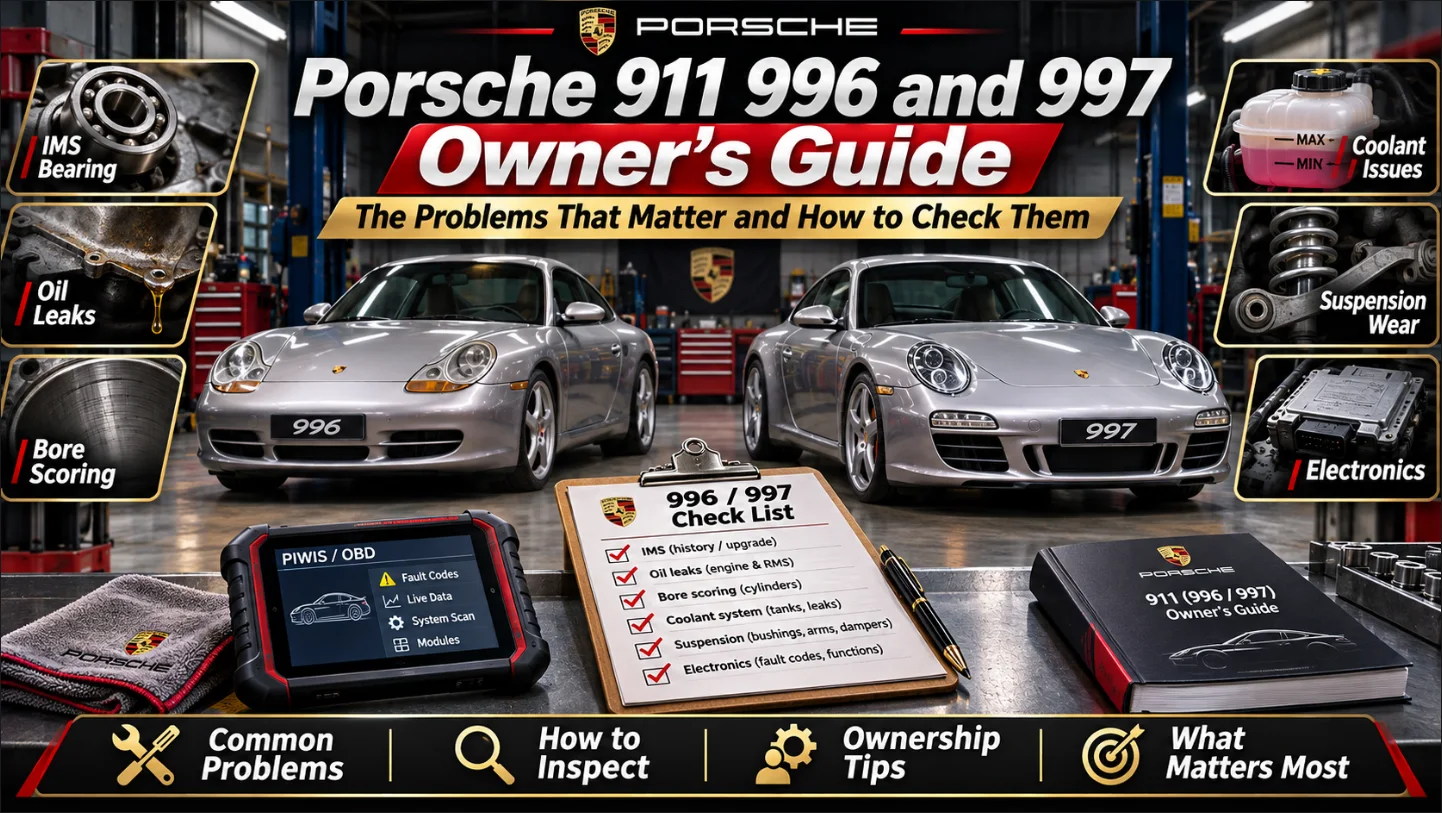
Porsche 911 996 and 997 Owner's Guide: The Problems That Matter and How to Check Them
A practical guide to the water-cooled 911 from 1999 to 2012: which engine your car has, the problems owners ask about most, what you can check yourself, and when it becomes a shop job.
In this article
This guide is for anyone who owns, is about to buy, or is wrenching on a water-cooled 911 from 1999 to 2012: the 996 and the 997. Their reputation is half earned and half internet noise. The problems depend on which engine you have, and most can be checked at home with jack stands, a filter cutter, a multimeter and a decent scan tool before you spend real money. The order below follows what owners ask about most.
Generations at a glance
The single most important fact about your car is its engine family. The Carrera and the Turbo/GT3 of the same year share a body and almost nothing else under the decklid.
| Generation | Model years | Engine family | What that means for problems |
|---|---|---|---|
| 996.1 Carrera | 1999–2001 | M96, 3.4 liter | Dual-row or single-row IMS bearing depending on build; bore scoring possible but less common than the 3.6 and 3.8 |
| 996.2 Carrera | 2002–2005 | M96, 3.6 liter | Single-row IMS bearing, the highest-risk factory design; 3.6 is one of the engines most often seen with bore scoring |
| 997.1 Carrera | 2005–2008 | M96/M97, 3.6 and 3.8 liter | Larger IMS bearing that can't be replaced without a teardown; the 3.8 is among the most common bore scoring cases |
| 997.2 Carrera | 2009–2012 | 9A1 (also called MA1) | No intermediate shaft, so no IMS bearing; Alusil bores can still score, at a much lower rate |
| 996/997 Turbo, GT2, GT3 | All years | Mezger-derived | IMS shaft on pressure-fed plain bearings, Nikasil bores, no AOS; watch the coolant pipe fittings, which can separate, instead |
Table sources: LN Engineering on the IMS[1], bore scoring[4][5] and the AOS[8], plus engine builders on the Mezger coolant pipes[15][14]. LN treats 2005 as a transition year[1], so go by the engine, not the title.
The problems owners ask about most
IMS bearing: should you retrofit, and by year
We have a full IMS bearing guide, so this is the short version for 996 and 997 owners.
What it is. On M96/M97 engines the crank drives an intermediate shaft that drives the cam chains. The back of that shaft rides on a sealed ball bearing. If it fails, the engine can lose cam timing and suffer severe internal damage[1].
Which cars, per LN Engineering[1]:
- 1999 996: dual-row bearing. Lower concern, not zero.
- 2000–2001 996: dual-row or single-row. Model year can't tell you which.
- 2002–2005 996: single-row. LN calls 2000–2005 the highest-risk years and cites a failure rate of about 8% during the warranty period, which it says should not be read as a lifetime rate.
- 2005–2008 997.1: larger bearing that can't come out without full engine disassembly. LN recommends removing its grease seal so oil can lubricate it.
- 2009–2012 997.2: no IMS bearing.
- Turbo, GT2, GT3 (all years): not affected. The shaft runs in pressure-fed plain bearings.
A factory replacement engine may have a different bearing than the car left the factory with, so verify the engine itself[1].
Our take. If your 2000–2005 car still has its original single-row bearing, plan the retrofit for the next clutch job at the latest. The bearing sits behind the flywheel and LN puts the job at 10 to 14 hours with the transmission out[2]. Before you do it, the engine should pass a pre-qualification that includes a scan tool check and a bore scope from the sump. LN says roughly 20% of inspected engines fail that check[3]. Putting a new bearing in a scored engine wastes the money.
DIY difficulty: Shop job for most people. It is doable at home with a lift, transmission support and the correct timing lock tools.
Pre-purchase on an early 996 or 997.1
Beyond the IMS, three things decide whether an M96/M97 car is a good buy: oil leaks at the back of the engine, the condition of the cylinders, and the over-rev history. The next sections cover each, and the buyer's checklist near the end pulls them together.
Bore scoring and engine rebuild cost
What it is. Wear of the cylinder wall and piston skirt in Lokasil (M96/M97) and Alusil (9A1) bores. The wall develops vertical grooves, clearance grows and oil consumption climbs[4].
Which cars. LN says the engines it most often sees with scoring are the 3.6 in the 996.2 and 997.1 and the 3.8 in the 997.1. The 996.1's 3.4 can score too, but less often. The 997.2's Alusil engine can still score, at a significantly lower rate. The Turbo and GT models use Nikasil plated bores that LN says are not susceptible to this kind of scoring[4][5].
Symptoms, per LN[4]:
- A ticking or tapping noise, often mistaken for a lifter, that is really piston slap.
- One exhaust tip sootier than the other.
- Rising oil consumption.
What you can check at home.
- Look at both tailpipes after a drive. One black, oily tip and one clean tip is a reason to look further.
- Track oil consumption between changes, in quarts per thousand miles, so you have a trend rather than a feeling.
- Read fuel trims and misfire counts with a scan tool. LN lists fuel trims, injector condition and AOS function as part of the diagnosis because they can accelerate wear[4].
- Book a proper bore scope. On these engines it has to be done from the sump, not through the spark plug holes[3]. Compression and leak-down can look fine on an engine with early scoring[4].
Fix options and cost. Scoring can't be reversed with oil or additives; the repair is a rebuild[4]. LN's figures for a 996 or 997.1: $5,000 to $6,000 for the block repair alone, and $15,000 to $30,000 or more for the full rebuild, with 80 to 90 hours of labor before removal and installation[5]. Those are a vendor's numbers, so get quotes.
DIY difficulty: Diagnosis is Moderate. The repair is a shop job.
Metal in the oil or filter
What to check. Cut the filter open at every oil change. LN says the dual-row IMS bearing can shed visible ferrous debris before it fails, but the single-row bearing may give little or no warning[1]. So a clean filter is good news but not proof.
- Cut the element out, unfold the pleats under a bright light and run a magnet over them. Ferrous flakes stick; aluminum and other non-ferrous material don't.
- Photograph what you find so you can compare next time.
- Send oil for analysis, but know the limit. LN says IMS wear particles are larger than 10 microns, so standard analysis won't flag a failing IMS bearing without a separate particle count test[1]. Analysis is still useful as a trend, and LN suggests sampling every 3,000 to 5,000 miles on gasoline engines[9].
If you find it. Don't keep driving to see if it gets worse. LN says once the bearing has started to fail, a straight bearing swap is no longer safe[2]. Have a specialist look at the debris and the engine first.
DIY difficulty: Easy to check. The response to a bad finding is a shop job.
Oil leaks: RMS, IMS flange, AOS and the rest
Rear main seal (RMS). The seal where the crankshaft exits the back of the engine. LN calls RMS leaks common on 996 and 997 engines and says a severe leak can damage the clutch[6]. Excellence calls the 996 RMS leak well documented[11].
The look-alike. The IMS flange sits in the same area between the engine and transmission and can leak too. Both LN and Excellence point out it can be mistaken for the RMS[6][11].
What to check. Look at the bottom of the bell housing where the engine meets the transmission. Clean the area, drive, and look again so you know where the oil is actually starting. LN says RMS leaks usually show up in a pre-purchase inspection[6].
The fix. LN says to use only the latest genuine Porsche PTFE seal, installed dry with the correct Porsche installation tool, and to replace the RMS any time the flywheel comes off[6]. If an existing seal is leaking, it says to check the crankshaft for runout before going further[3]. The PCA 996 Registry suggests crank vibration is the root cause and describes an aftermarket extra bearing; LN advises against that, and we list the disagreement with the sources[7][6].
Other leaks. Excellence says once the RMS and IMS flange are sorted, M96/M97 engines don't tend to leak much elsewhere, apart from spark plug tube O-rings on earlier M96 engines[11]. We did not find a source we trust on cam cover leak rates specifically, so diagnose those by cleaning and re-checking rather than by reputation.
DIY difficulty: Diagnosis is Easy. RMS replacement means removing the transmission and flywheel, so it is a shop job for most owners and sensible to combine with a clutch or IMS service[2].
Battery drain and parasitic draw
What it is. A battery that goes flat when the car sits. Some of that is normal: modules stay partly awake for the alarm and keyless systems, and a Porsche dealer says a battery left unattended can fully discharge in a few weeks[16]. Excellence says these cars can discharge within a month of sitting[11].
What to check. Start with the battery itself. Charge it fully and test it before blaming the car; our low battery warning lights guide covers the test. If it is healthy and still dies, do a parasitic draw test[17]:
- Fully charge the battery.
- Close everything or tape down the door, trunk, hood and glovebox light switches, and move the key well away from the car.
- Wait for the modules to sleep. ALLDATA allows 30 to 120 minutes depending on the car.
- Measure the draw. Either put an ammeter in series at the negative terminal, or read millivolts across each fuse so you don't wake modules by pulling fuses.
- Any circuit drawing more than 50 mA needs a closer look. Unplug components in that circuit until the reading drops.
On a 997, Excellence says a complete discharge or disconnection means PSM won't work properly until the steering angle sensor is recalibrated[11]. If you replace the battery, our battery replacement guide covers the rest.
DIY difficulty: Moderate. You need a multimeter and patience.
Long-term storage
Most of the storage advice is really battery and engine advice. A Porsche dealer recommends a smart maintainer if the car will sit more than about two weeks (it also says 10 days), a full oil service and fluid check before storage, correct tire pressures, and chocking the wheels instead of using the parking brake. For storage beyond six weeks it suggests disconnecting the negative terminal or removing the battery[16].
On the engine side, LN says IMS failures have historically been associated with cars that sit for long periods or do mostly short trips[1]. So if your M96/M97 car lives under a cover, the best thing you can do for it is drive it regularly and long enough to get fully warm (the dealer suggests 20 to 30 minutes about once a week[16]), and do the oil service before it goes into storage rather than after.
DIY difficulty: Easy.
Engine drop for big jobs
- IMS, clutch and RMS on a manual Carrera: transmission out, engine stays in. LN pairs this job with the clutch, RMS, AOS, water pump and dual-mass flywheel because they are all accessible at the same time[2].
- Tiptronic 911s: LN says the engine and transmission have to come out as a unit to separate them[2].
- Turbo, GT2 and GT3 coolant pipe repair: engine out[15].
- Any rebuild: engine out, obviously, and LN's 80 to 90 hours of rebuild labor does not include removal and installation[5].
Plan the "while you're in there" list before anything comes apart.
DIY difficulty: Shop job unless you have a lift, an engine table or cradle, and a workshop manual. Never work under the car on a jack alone.
Air oil separator (AOS) failure
What it is. The AOS is part of the crankcase ventilation system on M96, M97 and 9A1 engines. The Turbo, GT2 and GT3 don't use one. When it fails, crankcase vacuum rises and can pull oil into the intake[8].
Symptoms. LN says that on 996s and 997s, unlike the Boxster, a failed AOS often makes little or no tailpipe smoke. Early on it can cause misfires and fuel trim faults with a check engine light and few other clues, and the oily air can foul plugs and contaminate the oxygen sensors, catalysts and MAF[8].
What to check. Pull misfire counts and fuel trims with a scan tool; our check engine light guide and spark plug and coil guide help here. LN says the only definitive AOS test is measuring crankcase vacuum with a manometer. Its normal range for 996 and 997.1 engines is about -4 to -6 inches of water, rising to -10 to -15 or worse when the AOS fails. The 997.2 runs higher, about -14 to -16 normally and -20 to -25 or worse when failed[8]. LN also recommends keeping the oil level nearer the minimum mark than overfilled, to reduce load on the system[8].
Fix. LN treats the AOS as a maintenance item: genuine parts including the vent hoses, every 6 years or 75,000 miles[8].
DIY difficulty: Moderate. The test is easy with the right gauge. Many owners replace it at clutch time, since LN lists it among the jobs typically done alongside the IMS service[2].
Cooling system
On 996 and 997 Carreras. FCP Euro says the radiators sit low in the front bumper corners where debris blocks airflow, the plastic radiator tanks can crack, hoses can tear, the water pump bearing wears out around 60,000 miles, its plastic impeller can break up, and the oil heat exchanger can fail internally and mix oil and coolant[12]. Overheating can damage head gaskets and warp heads, and a coolant leak is often the first warning[13]. SharkWerks adds that the expansion tank cracks on its underside on 996s and 997s of every kind, Turbo and GT included[14].
On Turbo, GT2 and GT3. The Mezger-based engines have a separate, more serious issue: coolant pipe fittings coming out of their housings. Performance Developments says the repair needs the engine out to reach the elbows and water pump housing, and prefers welding the fittings over the pinning method many shops use[15]. SharkWerks replaces the expansion tank whenever one of these engines is out for coolant pipe work[14].
What to check.
- Look into the front bumper openings with a light for packed leaves and dirt.
- With the engine cold, look under the car and at the bottom of the expansion tank for dried coolant crust.
- Check the reservoir level cold and note whether it drops over a week of driving.
- If the oil or coolant looks milky, suspect the oil heat exchanger.
Our coolant leak and overheating guide covers pressure testing. When you refill, FCP says the long runs between the front radiators and the engine make bleeding difficult without a vacuum or pressure bleeder[12][13].
DIY difficulty: Moderate for radiators, tank and pump. Mezger coolant pipes are a shop job.
Maintenance that prevents most of it
Most of the list above gets cheaper or goes away with a handful of habits:
- Oil and filter on time, and cut every filter open. See our engine oil guide and maintenance schedule guide.
- Don't overfill. LN ties excess oil level to more load on the AOS[8].
- Drive it properly. Short trips and long sitting show up again and again in the IMS and storage advice[1][16].
- Fix fuel trim and misfire faults promptly. LN lists injector problems and fuel wash among the conditions that accelerate bore wear[4].
- Clean the radiator openings every year and refresh the cooling system before it fails, not after[12].
- Bundle the big jobs. IMS, RMS, clutch, AOS and water pump share access[2].
Our DIY tool kit guide covers the tools worth owning.
Buying one? Check these first
Run this before money changes hands, and pair it with our pre-purchase inspection guide:
- Confirm the engine. Carrera, Turbo or GT3, model year, and whether it is the original engine. Replacement engines can carry a different IMS bearing[1].
- IMS status (1999–2008 Carreras). Ask for the invoice if it has been done and which product was fitted.
- Over-rev report. The DME logs ignitions past the rev limiter. A 996 records two ranges; a 997 records six. LN's guide says ranges 3 and 4 call for compression or oil checks, ranges 5 and 6 are high risk, and the time of the last event matters too[10].
- Bore scope from the sump on 3.6 and 3.8 M96/M97 cars[3][4].
- Tailpipes and oil consumption. One sooty tip is a flag[4].
- Fuel trims and misfire counts on a scan, which can also point to the AOS[8].
- Underside. Wet bell housing (RMS or IMS flange), coolant crust at the expansion tank, debris in the front radiator openings[6][14][12].
- Oil filter. Ask the seller to let your inspector cut the filter at the inspection oil change.
- Turbo, GT2, GT3. Ask whether the coolant pipes have been pinned or welded and by whom[15].
Still stuck?
Post your year, model, engine and any codes in Porsche Technical Support, our free Facebook group, where owners and techs work through these exact problems every day. If you want someone to go through your scan data or filter photos with you one-on-one, that's what Tomorrow'sTek Garage Membership is for. And TekGarage is free: scan your VIN and it gives you your car's maintenance schedule and engine-correct parts.
Safety note: support the car on a lift or rated jack stands at the correct lift points, and never work under it on a jack alone.
Key specifications
| Item | Value | Status | Source |
|---|---|---|---|
| Normal crankcase vacuum, 996 and 997.1 (M96/M97) | about -4.0 to -6.0 inches H2O; a failed AOS can read -10 to -15 inches H2O or worse | Verified | [8] |
| Normal crankcase vacuum, 997.2 (9A1) | about -14.0 to -16.0 inches H2O; a failed AOS can read -20 to -25 inches H2O or worse | Verified | [8] |
| Recommended AOS replacement interval (vendor) | every 6 years or 75,000 miles, with the vent hoses and linesLN Engineering's recommendation, not a Porsche schedule item. | Verified | [8] |
| Parasitic draw that needs diagnosis (general guidance) | any circuit over 0.050 A (50 mA) after modules sleepGeneric test guidance, not a Porsche specification. | Verified | [17] |
Where sources disagree
Should an extra crankshaft support bearing be added to stop rear main seal leaks?
- [7] Blames crankshaft vibration and bearing 7 wear for RMS leaks and describes an aftermarket extra main bearing as a promising fix.
- [6] Says RMS leaks are not caused by the dual-mass flywheel and advises against adding a bearing; recommends the latest genuine Porsche PTFE seal fitted with the correct tool.
Our read: We side with the conservative route: a correctly installed current Porsche seal, after checking the crank for runout. Treat the add-on bearing as an unproven modification.
Sources
- Porsche IMS Bearing Problem Years: Boxster, Cayman, 996 & 997Retrofit manufacturer's guide. Sells IMS replacement kits, so its recommendations are attributed.
- IMS Solution Bearing Replacement Kit for Dual Row IMS MY97-01 Boxster & 911 ModelsProduct page; used for labor scope and what is typically done alongside the IMS job.
- IMS Pre-Qualification
- Porsche Bore Scoring: Symptoms, Causes, Diagnosis, Prevention, and RepairSells cylinder sleeving and rebuild services for these engines.
- Understanding Cylinder Bore Scoring Repair Costs for Porsche 911 996.1, 996.2 and 997.1 ModelsCost ranges are the vendor's own estimates; publication date not shown.
- How common is a Porsche RMS failure and how do I prevent one?
- Rear Main Seal FailureClub registry article; publication date not shown.
- Understanding the PCV and AOS Systems on Porsche Boxster, Cayman, and 911 Models
- How to Perform a Used Oil Analysis on Your PorscheSells oil analysis kits through SPEEDiagnostix.
- Porsche Ignition Over Rev Ranges GuideStates its information is accurate as of 2018.
- Technical Issues: 5 Common Porsche Problems
- 5 Of Our Favorite Cars With Notoriously Unreliable Cooling SystemsParts retailer's blog. Its Porsche section covers the 996 and 986.
- How To Replace & Upgrade Porsche 996 Radiators (Carrera 3.4L & 3.6L)
- Is coolant leaking from your 996 or 997? It could be your coolant expansion tankPorsche specialist shop and parts seller; publication date not shown.
- Coolant Pipe Failures on 996 & 997 Porsche Water Cooled EnginesEngine builder's tech article; publication date not shown. Describes its own preferred repair (welding).
- How To Maintain Your Porsche Battery If You Don't Drive Every DayDealer blog. It gives both 10 days and two weeks as the point to connect a maintainer.
- What's Draining Your Battery? Find Out with a Parasitic Draw Test
Diagnose first. Then turn the bolt.
Got one of these problems?
Post your year, model, engine and codes in Porsche Technical Support, our free 24K-member Facebook group. Owners and techs answer every day.