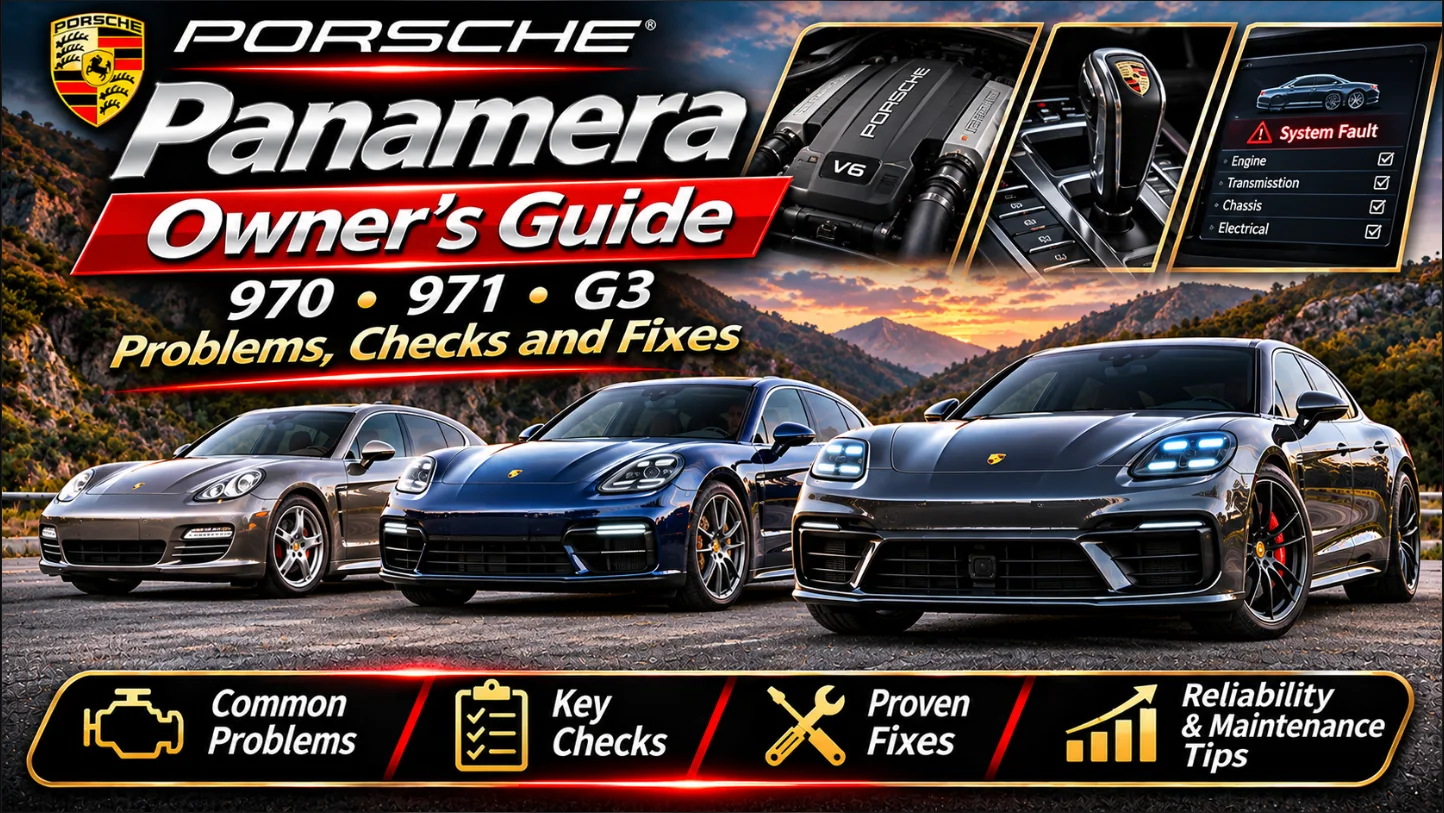
Porsche Panamera Owner's Guide: 970, 971 and G3 Problems, Checks and Fixes
The Panamera problems owners ask about most, in order: what each one is, which cars get it, how to check it yourself, and which recalls and Porsche bulletins apply to your car.
In this article
This guide is for people who own a Panamera, are about to buy one, or are standing next to one on a lift trying to figure out what they're looking at. It covers all three generations: the 970 (2010–2016), the 971 (2017–2023) and the current third generation that arrived for 2024.
The topics are in the order owners actually ask about them, not alphabetical. Recalls and Porsche bulletins are confirmed facts. NHTSA owner complaints are reports, not findings, and we label them that way. Every recall listed here was checked against NHTSA's records on November 11, 2026.
Generations at a glance
| Generation | US model years | Engines | Key differences | What it means for problems |
|---|---|---|---|---|
| 970 | 2010–2013 | 4.8 V8 (S, 4S, GTS), 4.8 twin-turbo V8 (Turbo), 3.6 V6 (Panamera, Panamera 4 from 2011), S Hybrid | Seven-speed PDK on most cars;[1] the US V6 cars got PDK as standard[2] | Cam adjuster bolt recall, coolant leaks, air springs, timing cover leaks |
| 970.2 | 2014–2016 | 3.0 twin-turbo V6 replaces the V8 in S and 4S; V8 stays in GTS and Turbo; S E-Hybrid plug-in arrives[3] | Executive long-wheelbase models[1] | Same family of engines (M46 V6, M48 V8)[7], so most 970 checks still apply |
| 971 | 2017–2023 | 3.0 V6 turbo (Panamera, Panamera 4),[5] 2.9 twin-turbo V6 (4S), 4.0 twin-turbo V8 (Turbo)[4] | Eight-speed PDK, rear-axle steering, three-chamber air suspension, Sport Turismo body[1] | New engine families (EA839 V6, EA825 V8)[7]; coolant pump bulletins, electronics recalls, more software |
| G3 | 2024 on | 2.9 twin-turbo V6 (Panamera, Panamera 4), four E-Hybrid powertrains including a revamped 4.0 V8 Turbo E-Hybrid[6] | Standard two-chamber, two-valve air suspension; optional Porsche Active Ride[6] | Still young; recalls so far are fuel pump fasteners and the rear camera[17] |
The engine split matters more than the badge. A 2013 Panamera 4S and a 2014 Panamera 4S have completely different engines, and a 971 base car and a 971 4S don't share the same V6 either. PistonHeads warns that some 3.0 cars have been de-badged and sold as 2.9s.[33] Confirm the engine from the VIN before you order parts or diagnose anything.
The problems owners ask about most
Steering or alignment problems after drivetrain work (971)
What it is. A steering wheel that sits off-center, a pull, or chassis warnings after the car has had major work, such as a transmission replacement. Anything that loosens suspension or subframe hardware can change alignment, and the car's electronics need to agree with the new geometry.
What Porsche says. Porsche's alignment bulletin covers every model line including the Panamera and names exactly these complaints: the car pulls to one side, or the steering wheel is out of line. It says alignment must use current adjustment values for the car's order type, and that if the work is sent to an outside alignment shop, that shop must be given the correct values.[24] For the 970, the workshop procedure also says a Panamera with air suspension must be set to normal level for alignment, at curb weight with a full tank, and aligned only in that position.[27] Porsche's workshop procedure for other models states that the steering angle sensor must be calibrated with a Porsche tester whenever alignment values are changed, and that the rear axle is set first when both axles are measured.[28] We did not find the 971-specific procedure in a public source, so have a Porsche-capable shop confirm what your car needs.
Rule out the recall too. 2017–2018 Panameras, including Sport Turismo and E-Hybrid models, were recalled for a software failure that could cause intermittent loss of electric power steering assist. Dealers reprogram the steering control unit.[12]
What to check. Scan the chassis and steering modules for stored faults, confirm 18V898000 is closed for the VIN, then get a four-wheel alignment with the car at normal ride height using Porsche's values. On cars with rear-axle steering, make sure the shop knows it's there.
Difficulty: Shop job (alignment rack plus a Porsche-capable scan tool).
P0016 and cam timing faults on 2010–2014 cars
What the code means. P0016 says the bank 1 camshaft signal doesn't agree with the crankshaft signal. Generic causes include a chain that has jumped teeth, a cam phaser out of position, restricted oil flow to the phaser, or a sensor fault.[30] On a 970, replacing the crank sensor and still having the code is a reason to look harder at the mechanical side.
The recall you must know about. NHTSA campaign 17V368000 (Porsche AH08) covers 2010–2012 Panamera S, 4S and Turbo, and 2011–2012 Panamera and Panamera 4. The camshaft controllers can come loose inside the engine and the engine can stall. The remedy is new fastening screws for the camshaft adjusters.[8]
The owner complaints for these cars are blunt. 2011 owners describe adjuster bolts shearing, stalls at highway speed, metal in the oil pan and full engine replacements, and several describe waiting on recall parts.[20] A 2011 Turbo owner reports the same failure and the loss of power assist that came with the stall.[21] A 2010 4S owner reports a check engine light and rough running that a dealer tied to this campaign.[19] One 2014 owner, outside the recall's model years, reports a dealer diagnosis of failed bank two camshaft adjuster central bolts after a knock and a stall.[22] Treat those as reports, but take them seriously.
What to check. Run the VIN for 17V368000 at nhtsa.gov/recalls or a Porsche dealer before anything else. Read every code in the engine module with a Porsche-capable tool, not just the generic P-code, and check the oil filter for metal. If the car is knocking or has stalled, stop driving it.
Difficulty: Sensor and wiring checks are Moderate. Anything involving the cam adjusters is a Shop job.
High-mileage 970 V6 (2011–2016 Panamera and Panamera 4)
The 3.6 V6 is a 90-degree, direct-injected engine built on the same line as the 4.8 V8.[2] On a high-mileage car, work through the same list as a V8:
- Cam adjuster recall for 2011–2012 cars, above.[8]
- Timing cover oil leaks. Excellence reports leaks from the front timing covers on 970 V8 and V6 engines, caused by aluminum cover bolts that fatigue and break. The fix is replacing all the aluminum fasteners using a torque-angle procedure.[31]
- Cooling system. PistonHeads lists overheating and coolant leaks from the auxiliary coolant pump, thermostat housing and water pump as first-generation issues.[33]
- Shifter recall. 2010–2016 Panameras were recalled because the bushing that attaches the gear selector cable to the gearbox can detach, letting the lever show Park when the transmission isn't in Park. The remedy is a new bushing.[11] Owners of 2014 cars describe exactly that: the car rolling after being put in Park.[22]
- Blower recall. 2010–2016 cars: water can get into the A/C blower control unit and short it, with a fire risk. Porsche recommended parking outdoors until it's fixed.[10]
- Battery. From the 970 on, Porsche uses AGM batteries that must be registered with a factory-level scan tool when replaced.[31]
Leaks and damage found on a lift (970 Turbo)
When a 970 is up in the air, these are the places that tell the story:
- Front of the engine: wet timing cover edges point to the bolt issue above.[31]
- Middle of the car: PistonHeads says to check for oil leaks from the PDK, and puts a new gearbox sump cover at around £350 in 2017 UK money.[32]
- Air springs: look at the bellows and fittings, front first (more below).
- Coolant residue under the engine and around the front.
- Radiators: PistonHeads says leaves and debris collect in the front radiators and can corrode them and the pipework.[32]
Turbo-specific: 2011–2012 Panamera Turbo and 2012 Turbo S were recalled for turbine wheels that could fracture from a casting defect. If the shaft breaks, oil can be drawn into the exhaust, with smoke and fire risk.[9] Confirm it was done.
Before you lift a 970 with air suspension, switch the leveling system off: ignition on, hold the High Level button for at least 10 seconds, and wait for "Control off" in the cluster. Lift only at the take-up points.[29]
Check engine light on a 2010 4S
Start with the recall. The 2010 4S is inside 17V368000, and a 2010 4S owner reports a check engine light and rough running tied to it.[8][19] After that, it's ordinary diagnosis: pull every code with a tool that can see Porsche manufacturer codes, not just the generic ones. 2010 owners also report high-pressure fuel pump failures with loss of power.[18] Our check engine light guide explains how to read the codes, and the scan tool guide covers which tools talk to a Panamera. If you want the factory-level picture, see what PIWIS is.
2018 base Panamera 3.0 V6 faults (971)
The 2017–on base Panamera and Panamera 4 use a 330 hp 3.0 V6 turbo,[5] which Porsche's oil bulletin lists as the EA839 LK2 in the base car.[7] It's a different engine from the 4S's 2.9 twin-turbo.[33] PistonHeads found no sign of endemic engine problems with second-generation V6s.[33] What does show up on 971s is mostly cooling and electronics:
- "Coolant temperature too high." Porsche bulletin 173/21 says a faulty coolant pump on the 971 can be caused by a faulty change-over valve, and tells technicians to check the valve whenever the pump is faulty or leaking.[25] Bulletin 2307 says the vacuum changeover valve controlling the water pump's sleeve can stick intermittently on 2017–2021 Panameras and set the warning, with cluster fault B19A750.[26] One 2018 4S owner reports a water pump seal failure that pushed coolant into the vacuum lines and solenoids.[23]
- Climate coolant pump recall. 2017–2021 Panamera, Panamera 4, GTS and Turbo: humidity can get into the external coolant pump for the climate control and short it, with a fire risk. Dealers replace the pump and check the connector.[15]
- Control unit recall. Some 2018 Panameras, including base and Panamera 4, had an incorrectly soldered control unit that could cause intermittent failures of various systems.[13]
- Power steering software recall 18V898000, above.[12]
See our coolant leak and overheating guide for the diagnostic steps.
Difficulty: Reading codes and checking recalls is Easy. Coolant pump and valve testing is a Shop job; the bulletin calls for PIWIS and a hand vacuum pump.[25]
Tracking down noises
- Creaks and rattles on a 970: PistonHeads points at drop links and lower arm joints.[32]
- Rear noises on a 971: check the paperwork for a rear anti-roll bar link recall, which PistonHeads reports from the UK market.[33]
- 2021 cars: front lower trailing arms that weren't forged correctly and may break were recalled.[16]
- Engine knock or rattle on a 2010–2014 car: treat it as the cam adjuster problem until proven otherwise. A 2011 owner reports a dealer calling for a camshaft replacement after abnormal noises.[20]
What to check. Reproduce the noise and note when it happens: over bumps, turning, braking, cold start or under load. Chassis noises get checked on a lift with a pry bar on each joint. Engine noises get checked with the engine running and a stethoscope, never with hands near the belt.
Air suspension
What it is. Most Panameras have air suspension, and on older cars the springs and compressor wear out.
Symptoms. PistonHeads says a 970 that sags after standing for a long time, and doesn't come back to the correct height once the engine is running, most likely has a leaking air spring, most often at the front. Air springs are replaced in pairs, and they put the bill at "at least £2,000" from a UK specialist in 2017.[32] On a 2018, one owner reports a failed plastic mount on the front ride height sensor that upset the air suspension.[23]
What to check. Park it level overnight and measure each corner's fender height before and after. Listen for the compressor running too long or too often. Scan the leveling module for faults. Check that the ride height sensors' links and brackets are intact.
Difficulty: Diagnosis is Moderate. Spring and compressor replacement is Moderate to Shop job depending on your lift and tools. Remember the "Control off" step before lifting.[29]
PDK
The 970 uses a seven-speed PDK on most cars, and the 971 moved to an eight-speed.[1] PistonHeads calls the 970 gearbox robust, if slow to shift in auto mode, and says to look for leaks under the middle of the car.[32] On the 971 it notes the box can be slightly jerky at town speeds, and that resetting the PDK software can smooth out a used car.[33]
The complaints tell a rougher story for some cars. Several 2018 owners report a "reverse not available" message with the gearbox stuck in one gear, with repeat dealer visits.[23] A 2011 owner reports a failure to shift with transmission and check engine lights.[20]
What to check. Scan the transmission module for stored faults, check for leaks at the sump, and on 970s confirm the shifter recall 19V446000 is closed.[11] Ask for fluid service records; our PDK service guide covers intervals.
Difficulty: Scanning and leak checks are Easy. Software resets need a Porsche-capable tool. Internal faults are a Shop job.
Coolant pipes and leaks on V8s (970)
This one has the thinnest public paper trail. We did not find a Porsche bulletin or recall for coolant pipes on the 970's 4.8 V8. What we did find: PistonHeads lists thermostat housing, water pump and auxiliary pump leaks as first-generation issues,[33] and a 2011 owner reports a coolant warning, a leak at the coolant bypass hose under the intake, and coolant pipes in the thermostat housing coming loose at the bonded joint.[20] Treat the pipe cause as an owner explanation until a tech sees it.
What to check. Low coolant warnings, a sweet smell after a drive, and dried pink or crusty residue at the front of the engine and in the valley under the intake. Pressure-test the cooling system cold before you start pulling parts.
Difficulty: Pressure testing is Easy. Anything under the intake is a Shop job or a long weekend for an experienced DIYer.
Buying an auction Panamera
An auction car is a car with no seller to answer questions. Assume nothing:
- Run the VIN for every open recall. The 970 alone has the cam adjuster, turbo turbine, shifter and blower campaigns.[8][9][11][10]
- Look for water damage. 2010 owners report clogged rear hatch drains filling the battery area with water and shorting rear electrics.[18][19] 2011 owners report water coming through the A/C vents.[20]
- A car that has sat may sag on its air springs.[32]
- On hybrids, PistonHeads says battery condition is paramount.[33] 2018 hybrids also had a front brake line corrosion recall.[14]
- Budget for a full Porsche-capable scan and a lift inspection before the car goes back on the road.
Maintenance that prevents most of it
Most of the expensive outcomes above get worse with neglect: low or wrong oil for the cam adjusters, old coolant, and leaking air springs left until the compressor burns out. Use the oil spec Porsche lists for your engine; the 971 base engine, for example, is assigned a different approval from the 4S.[7] Our Porsche maintenance schedule and PDK service guide cover intervals, and the 2026 recall roundup covers what's open now.
Buying one? Check these first
- VIN checked for all open recalls and campaigns
- Engine confirmed from the VIN, not the badge
- Full scan of every module, including manufacturer codes, with fault history
- Cam adjuster recall done on 2010–2012 cars, with paperwork
- Ride height level at all four corners after sitting overnight
- No coolant warnings, residue or sweet smell
- Timing covers and PDK sump dry on a lift
- Shifter shows Park and the car actually holds in Park on a slope
- Rear hatch drains clear, no water in the battery area or footwells
- Alignment and steering wheel straight on the test drive
- Hybrid battery health checked by a dealer on E-Hybrid cars
Pair this with our pre-purchase inspection guide.
Still stuck?
Post your year, model, engine and codes in Porsche Technical Support, our free Facebook group of 24,000 owners and techs, and someone who has seen it before will usually answer. If you want one-on-one help working a problem through, that's what Tomorrow'sTek Garage Membership is for. And TekGarage, our free app, scans your VIN for your car's maintenance schedule and engine-correct parts, which is the fastest way to stop guessing which Panamera you have.
Safety note: only work under a Panamera on a lift or rated jack stands at the correct lift points, with the air suspension's leveling switched off first.
Key specifications
| Item | Value | Status | Source |
|---|---|---|---|
| 2011 Panamera and Panamera 4 engine (US) | 3.6-liter V6, direct injection, 300 hp, seven-speed PDK standard | Verified | [2] |
| 2017 Panamera 4S engine | 2.9-liter twin-turbo V6, 440 hp, eight-speed PDK | Verified | [4] |
| 2017 Panamera and Panamera 4 engine | 3.0-liter V6 turbo, 330 hp | Verified | [5] |
| 2024 Panamera and Panamera 4 engine | 2.9-liter twin-turbo V6, 348 hp, eight-speed PDK | Verified | [6] |
Sources
- 10 years of the Porsche Panamera: sports car, luxury saloon, hybrid pioneer
- The Summer Driving Season Kicks Off with Two New Porsche Panamera Models in Dealer Showrooms
- 2014 Porsche Panamera Model Line Debuts in US Market
- New 2017 Panamera
- LA Auto Show to see debut of Panamera and Panamera Executive models
- The new Panamera: more digital, more luxurious, more efficient
- Allocation of Approved Engine Oils Until MY 2020 (12/25), Technical Bulletin 1701Lists engine families by model: M46/M48 for the 970, EA839 and EA825 for the 971.
- NHTSA recall 17V368000: camshaft controllers may come loose (Porsche AH08)
- NHTSA recall 12V329000: turbocharger turbine wheel may fracture
- NHTSA recall 19V322000: water may enter the A/C blower control unit (Porsche AKA7)
- NHTSA recall 19V446000: gear selector cable bushing may detach (Porsche AKB1)
- NHTSA recall 18V898000: intermittent loss of electric power steering assist (Porsche AJ13)
- NHTSA recall 19V180000: incorrectly soldered control unit (Porsche AKA5)
- NHTSA recall 18V841000: front brake lines may corrode on 2018 hybrids (Porsche AJ11)
- NHTSA recall 23V033000: external coolant pump for climate control may short circuit (Porsche APA1)
- NHTSA recall 21V362000: front lower trailing arms may break (Porsche AMB2)
- NHTSA recalls by vehicle: 2024 Porsche PanameraReturns campaigns 25V634000 (high-pressure fuel pump fasteners) and 25V896000 (rearview camera).
- NHTSA complaints by vehicle: 2010 Porsche PanameraOwner-submitted complaints, not verified by NHTSA.
- NHTSA complaints by vehicle: 2010 Porsche Panamera 4SOwner-submitted complaints, not verified by NHTSA.
- NHTSA complaints by vehicle: 2011 Porsche PanameraOwner-submitted complaints, not verified by NHTSA.
- NHTSA complaints by vehicle: 2011 Porsche Panamera TurboOwner-submitted complaints, not verified by NHTSA.
- NHTSA complaints by vehicle: 2014 Porsche PanameraOwner-submitted complaints, not verified by NHTSA.
- NHTSA complaints by vehicle: 2018 Porsche PanameraOwner-submitted complaints, not verified by NHTSA.
- Technical Information 89/11: Adjustment Values for Suspension Alignment
- Technical Information 173/21: Warning Message "Coolant Temperature Too High": Checking Coolant Pump and Change-Over Valve
- Advanced Technical Information Bulletin 2307: Display of "Coolant temperature too high" in Group V6 and V8 Engines
- Panamera S (970) V8-4.8L: Adjustment Values for Suspension AlignmentThird-party reproduction of Porsche workshop alignment prerequisites for the 970. Undated.
- Cayman S (987): Suspension Alignment SpecificationsThird-party reproduction of a Porsche workshop procedure for a different model, cited for the general steering-angle sensor rule. Undated.
- Panamera S (970) V8-4.8L: Vehicle Lifting, Service and RepairThird-party reproduction of workshop lifting instructions for the 970. Undated.
- P0016 OBD-II Trouble Code: Camshaft Position A - Camshaft Position Correlation (Bank 1)Generic OBD-II code explanation; no publication date shown.
- 5 Common Porsche Problems
- Porsche Panamera (970) | PH Used Buying GuideUK market; prices in pounds as of 2017.
- Porsche Panamera (971) | PH Used Buying GuideUK market.
Diagnose first. Then turn the bolt.
Got one of these problems?
Post your year, model, engine and codes in Porsche Technical Support, our free 24K-member Facebook group. Owners and techs answer every day.