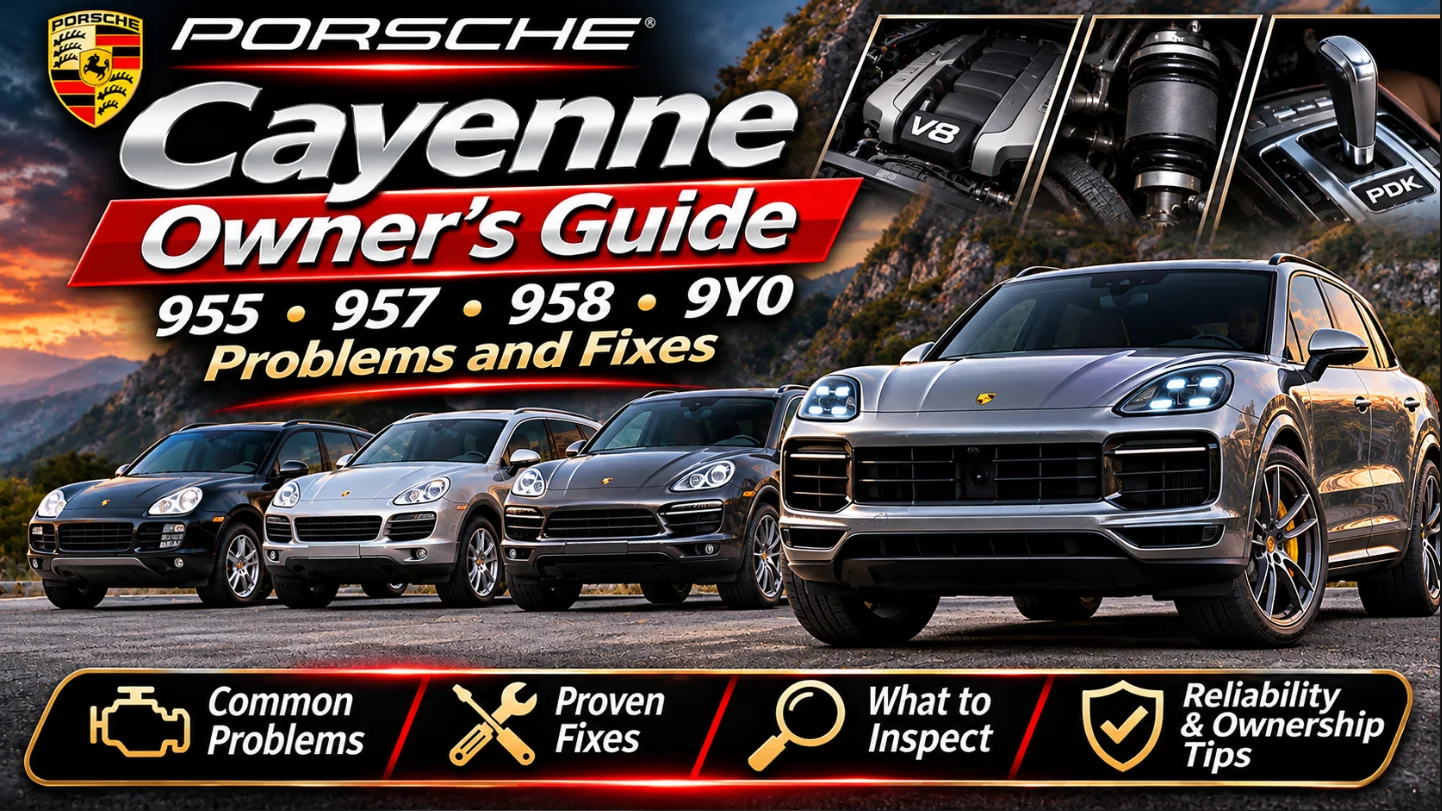
Porsche Cayenne Owner's Guide: 955, 957, 958 and 9Y0 Problems and Fixes
Every Cayenne generation from the 2003 955 to the current 9Y0, and the problems owners actually ask about: coolant pipes, the driveshaft center bearing, transfer cases, air suspension, bore scoring and hybrid faults, with what to check and how to fix it.
In this article
This one is for people who own a Cayenne, are about to buy one, or are standing in the driveway trying to figure out what that noise is. It covers all four generations, from the 2003 955 to the current 9Y0, and it is ordered by what owners ask about most, not by what makes the best headline.
Recalls and Porsche technical bulletins are confirmed facts. NHTSA owner complaints are reports, not findings, and parts-vendor guides are marked as vendor sources. Recall data was checked against NHTSA on November 11, 2026.
Generations at a glance
The Cayenne was co-developed with Volkswagen and shared a platform with the Touareg, though each brand used its own engines and chassis tuning[1]. That's why some Cayenne driveline fixes are listed for the Touareg too.
| Generation | US model years | Engines | Key differences | What that means for problems |
|---|---|---|---|---|
| 955 | 2003–2006 | 3.2 VR6, 4.5 V8, 4.5 twin-turbo V8[31] | Low-range transfer box, locking center diff, port injection[1][31] | Plastic coolant pipes, driveshaft center bearing, bore scoring on the 4.5 V8 |
| 957 | 2008–2010 | 3.6 VR6, 4.8 V8, 4.8 twin-turbo V8[31] | Facelift, direct injection, GTS added[1][31] | Glued coolant barb on the 4.8, same center bearing, HPFP on the V8 |
| 958 | 2011–2018 | V6, S, GTS, Turbo and Turbo S[7], S Hybrid, then S E-Hybrid plug-in from 2014[1] | Low-range box dropped for an on-demand multi-plate clutch transfer case[1] | Transfer case, first hybrids |
| 9Y0 | 2019–present | 3.0 V6, 2.9 twin-turbo V6 (S), 4.0 twin-turbo V8, E-Hybrids[2][1] | Aluminum body, three-chamber air suspension, rear-axle steering, mixed tire sizes[1][3] | 12V battery and electrical faults, hybrid cooling warnings |
The 9Y0 got a major update in 2023: the Cayenne S switched back to a 4.0 twin-turbo V8, steel springs with PASM became standard with air suspension optional, the E-Hybrid battery grew from 17.9 kWh to 25.9 kWh, and the cabin moved to a fully digital 12.6-inch cluster with a 12.3-inch PCM screen[4][1].
The problems owners ask about most
Keeping a high-mile 955 Turbo running
The 955 Turbo and Cayenne S share the 4.5 V8 family, and the same three things come up again and again: coolant pipes, air suspension and ignition.
Coolant pipes. The 4.5 V8 used composite plastic coolant pipes under the intake manifold, and they crack and leak[31]. This was big enough to end up in a class action covering 2003–2006 V8 Cayennes built between January 28, 2002 and December 5, 2006. Porsche denied wrongdoing but settled, and owners had been charged up to $3,600 for the aluminum replacement kit at the time[29]. The claim deadline passed in December 2014[29], so there is no money left on the table now.
Owners describe the failure as sudden: the pipes let go on the road, dump the coolant, and the car gets towed[20][21].
- Symptoms: coolant smell, an expansion tank that keeps dropping, wet residue in the engine valley. Leaking coolant can also reach the starter and the torque converter seal[31].
- What to check: look for aluminum pipes when the intake is off, or for an invoice showing the pipe kit. If the car still has original plastic pipes, budget for them now rather than on the shoulder of the highway.
- Fix: aluminum pipe kit, which means pulling the intake. DIY difficulty: Moderate to shop job. Do the thermostat and water pump while you're in there if they're due.
The 4.8 V8 in the 957 has its own version of this, covered below under plastic coolant pipes. Our coolant leak and overheating guide walks through pressure testing.
Air suspension. It was optional on every 955/957 and standard on the Turbo and Turbo S. The system is four air struts, a compressor in the right front wheel housing under the underbody panel, an air tank, a valve block and a control unit[32].
- Compressor: can just stop. Height loss is slow at first because the tank still holds pressure, and a chassis system fault appears[32].
- Valve block: air leak or electrical fault, dropping one corner, one axle or the whole car[32].
- Struts: usually leak at the hose connection rather than the bag itself. One corner low after sitting overnight is the classic sign[32].
- Level sensors: a bad sensor can put one corner at the wrong height without setting a fault, so check it before buying a strut[32].
What to check: the generic "chassis system failure" message doesn't tell you which part failed, so you need a scan tool that can read the level control module[32]. Confirm the compressor relay has power before condemning the compressor. If the compressor runs more than it used to, you have a leak somewhere[32]. A spray bottle of soapy water on the strut fittings and lines finds most of them. DIY difficulty: Moderate for a compressor or strut, Easy for a relay. See our scan tool guide for tools that talk to the chassis modules.
Ignition. Coils fail on every first-generation engine. Replace them as a set, and stop driving on a flashing check engine light[31]. On the 4.5 V8 this matters more than usual, because a misfiring cylinder washes oil off the cylinder wall and that feeds the bore scoring problem below[31]. Our spark plugs and ignition coils guide covers the job. DIY difficulty: Easy to Moderate.
Driveshaft center bearing on the 955 and 957
The rear driveshaft on first-generation Cayennes is two pieces with a rubber-mounted center support bearing. Over time the rubber splits, the bearing stops supporting the shaft, and the shaft starts moving around[34].
- Symptoms: cracking or clunking noises and harsh vibration in the cabin, especially on acceleration and deceleration[34]. Owners filing with NHTSA describe vibration on take-off, a wobble at speed with a loud noise, and in some cases a driveshaft that separated[20][21][22][23]. One 2008 owner reports a mechanic found excessive axial play in the center support bearing[22].
- What to check: on a lift, look at the rubber around the center bearing for cracks and tears, and grab the shaft near the bearing and try to move it. Check the flex disc (guibo) at the front while you're there.
Porsche part vs aftermarket. Here is the catch: Porsche does not sell the center bearing on its own. From the factory it only comes with the complete driveshaft, which is why the dealer quote is the whole shaft[34]. Aftermarket suppliers fill that gap. Febi, for example, sells a center support repair kit with the bearing, boot, retaining clip and grease, listed for the 9PA (955/957) Cayenne and the 7L Touareg[34].
The trade-off is labor and judgment versus cost. A new Porsche shaft replaces every joint at once. A bearing kit fixes the bearing, but Febi's own instructions say to remove the shaft and inspect all the joints and the flex disc for wear, replacing them as needed[34]. If the joints are worn, a bearing alone won't cure the vibration. DIY difficulty: Moderate, mainly because the shaft has to come out and the joint must go back in the same orientation (mark it before you separate it).
Whine or noise from the front on a 958 Cayenne S
A whine that seems to come from the front of a 958 has three usual suspects: the transfer case, the front differential and driveshafts, and the front wheel bearings. Of those, the transfer case is the one with a paper trail.
The 958 uses an active all-wheel-drive transfer case with an electronically controlled multi-plate clutch[1][7]. Porsche's bulletin on it lists the documented symptoms as creaking or clicking noises from around the transfer case, rough running, and jerking under load, and it covers 2011–2017 Cayenne V6, S, GTS, Turbo and Turbo S[7]. The fixes in that bulletin are reprogramming the all-wheel-drive control unit (2015–2016 cars, for the creaking noise) or replacing the transfer case (for jerking under load)[7]. Later replacement units use clutch plates with a gas nitrocarburized coating, and the control unit software has to match the unit[7]. A small group of 2011 Cayenne S and Turbo models also had a workshop campaign to replace transfer cases with defective clutch baskets that caused vibration[8].
The bulletin also makes a point every owner should hear: a high percentage of warranty-returned transfer cases tested fine at the supplier, and some drivetrain strain in tight, slow turns is normal for this design, especially in off-road mode[7]. In other words, diagnose before you buy a $5,000 part.
The warranty extension, and why it probably won't help you now. Porsche extended transfer gear coverage on 958 Cayennes to 10 years from new-vehicle delivery for 2011–2014 models and 7 years for 2015–2018, with unlimited mileage, transferring automatically to the next owner[5][6]. Porsche said long-term durability "may be below Porsche's high quality standards"[30]. Do the math on delivery dates and almost every one of these cars has aged out of coverage. A dealer can still check the exact end date for a VIN in Porsche's system[5]. Owners in NHTSA complaints report transfer case repairs around $5,000 to $6,300, some of them on a second or third unit[24][25][27].
What to check, in order:
- Note when it happens. A whine that changes with road speed but not engine speed, and gets louder in a sweeping turn one way, points toward a wheel bearing.
- Scan the all-wheel-drive control unit for faults and check its software level against the bulletin.
- Pull away gently and make slow, tight turns in a parking lot with off-road mode off. Clicking, shudder or a lurch on take-off points at the transfer case.
- On a lift, spin each front wheel by hand and check for roughness and play, then check the front driveshaft and its joints.
DIY difficulty: Easy for the diagnosis steps, Shop job for a transfer case (it needs matching software and, on 2011–2012 cars, classification data written to the control unit)[7].
Buying a Cayenne Turbo S sight unseen
Buying a rare Turbo S from across the country is fine, as long as an independent inspector who knows Cayennes checks the right things:
- 955/957 Turbo S: coolant pipe history, center bearing and flex disc, air suspension operation at every height, a bore scope of the cylinders, coil and plug records.
- 958 Turbo S: transfer case behavior on a cold and warm drive, and any transfer case replacement records.
- 9Y0 Turbo S E-Hybrid: hybrid system faults, 12V battery health, and every open recall.
Ask for a full scan of every control unit, not just a check engine readout. The full checklist is below.
Bore scoring: 955/957 V8 and the 2.9 twin-turbo
First generation. The main concern is the 4.5 V8, both the naturally aspirated M48.00 and the turbo M48.50, and the Cayenne S seems to suffer more than the Turbo. FCP Euro's engine guide attributes this partly to coating durability and to the Turbo's piston oil squirters, and says the 957's 4.8 engines don't share the same major concern because of changes to block materials and coatings[31]. Treat that as a vendor's read, and note that 4.8 owners do still have cars scoped.
- Symptoms: oil consumption, misfires, power loss, and in bad cases a knock at idle[31].
- What to check: a bore scope through the plug holes is the real test. Oil analysis and a compression or leak-down test help. A misfire history matters, because misfires make it worse[31].
- Fix: there is no cheap repair because the block itself is damaged. FCP Euro suggests a known-good used engine as the realistic option[31]. DIY difficulty: Shop job.
The 2.9 twin-turbo in the 2019+ Cayenne S. We looked for evidence of bore scoring on this engine and didn't find any we could stand behind: no recall, no Porsche bulletin, and none of the 48 NHTSA complaints filed against 2019 Cayennes describe scoring or oil consumption[28]. That means the pattern isn't documented, not that any one engine is safe. A bore scope and oil analysis settle it for a specific car.
E-Hybrid faults on road trips
Porsche's first series hybrid was the 2010 Cayenne S Hybrid, followed by the 2014 S E-Hybrid plug-in, and the 9Y0 E-Hybrids since[1]. Owner complaints describe faults and warnings that appear while driving, some of which clear on their own:
- 958 S Hybrid: a "hybrid system failure" message while driving or at start-up, with the system then not charging properly, and in some reports loss of power on the highway[24][25]. There was also a recall for leaking fuel rails on 2011–2012 Cayenne S Hybrids[16].
- 958 S E-Hybrid: a charging plug that would not release, with the code P0D94 for a charging-plug lock fault[26].
- 9Y0 E-Hybrid: a red "Hybrid coolant level too low" warning appearing repeatedly while driving[28].
What to check before a long trip: the hybrid coolant level (the warning owners report), any stored hybrid or high-voltage faults, and the 12V battery. Also confirm recall 23V841000 is done: the 220V/240V portable charging cable can overheat a home outlet, and Porsche supplies a replacement cable with a temperature sensor[17].
Rusty brake rotor hats
We didn't find a Porsche bulletin on hat rust. The checks that matter are rotor thickness against the minimum stamped on the rotor, the lip at the outer edge, and pulsing in the pedal. Our brake pads and rotors guide covers measuring and replacing. One 9Y0-specific note: the optional Porsche Surface Coated Brake uses a tungsten-carbide-coated cast-iron disc, came only with 21-inch wheels, and is identified by white calipers[3]. Don't treat it like a regular iron rotor when you buy pads.
Wheel and tire sizing
The 9Y0 runs mixed tire sizes, with wheels of at least 19 inches and up to 21 inches at launch[3], and 20 to 22 inches after the 2023 update[4]. Mixed sizes mean front and rear tires are different, so you can't rotate them front to back.
Whatever generation you have, match the size on the tire placard and stick with N-marked tires where they exist. Porsche says N-marked tires are tested by its engineers, including high-speed and rolling-resistance testing, and only those that pass get the mark[9].
Plastic coolant pipes beyond the 955
The 4.5 isn't the only one. On the 957's 4.8 V8, the rear crossover pipe has a glued-in hose barb that can loosen as the adhesive ages, which causes a sudden major leak. The updated part has a threaded barb, but fitting it means partially removing the engine. The valley pipe is plastic with an aluminum update, and the upper front pipes are bonded into the thermostat housing, with a bolted update from Porsche[31]. Owners of 2008 Cayennes describe exactly this: the barb on the coolant distributor at the back of the engine coming unglued and dumping coolant on the highway[22]. 2011 owners report plastic coolant tubing that turned brittle and cracked[24].
The VR6 has its own weak pipe between the water pump and thermostat housing on the 3.2, which cracks at a barb fitting[31].
What to check: look at the back of the engine for crusty pink residue, pressure test the system cold, and look for paperwork showing updated parts. DIY difficulty: Shop job for the 4.8 rear barb, Moderate for the rest.
PCM and electrical faults
Most electrical gremlins on any Cayenne start with a weak 12V battery. Low voltage produces strange, unrelated warnings, and the first step is always to test the battery and charging system before chasing modules. Our low battery and warning lights guide explains how.
On 9Y0 cars, owners report problems with the lithium 12V battery and its built-in management electronics, including warnings, sudden shutdowns that required a replacement battery, and long waits for parts[28]. Owners of 2019 E-Hybrids also report driver-assistance and lighting error messages cycling continuously[28].
On first-generation cars, check the footwells for water. A 2005 owner linked an ignition lock fault and other warnings to poor water drainage[20].
There's also a recall for 2019–2025 Cayennes whose rearview camera image may not display in reverse[18][19].
Recalls worth confirming
Run the VIN through nhtsa.gov/recalls or ask a dealer. These are the Cayenne campaigns most likely to matter on a used car:
| Campaign | Years | Issue |
|---|---|---|
| 04V071000 | 2004 | Transfer case oil starvation[10] |
| 17V576000 | 2003–2006 gasoline | Fuel pump flange may crack and leak[11] |
| 08V076000 | 2008 V6 | Fuel line may chafe on the engine cover[13] |
| 19V446000 | 2003–2010 (varies by trim) | Shifter bushing can detach, so the car may not be in Park[12] |
| 12V065000 | 2011–2012 | Headlamps may come loose[14] |
| 16V169000 | 2011–2016 | Brake pedal pivot pin circlip may be missing[15] |
| 15V016000 | 2011–2012 S Hybrid | Fuel rails may leak[16] |
| 21V271000, 21V493000 | 2021 | Rear axle trailing arm lock nut; steering column screw[18] |
| 24V533000, 25V634000 | 2024 on | Cracked front upper control arm; high-pressure fuel pump fasteners[19] |
| 23V841000 | E-Hybrids | 240V portable charging cable can overheat[17] |
For more, see this year's Porsche recalls.
Maintenance that prevents most of it
FCP Euro's buyer's guide puts it bluntly: lack of service and deferred maintenance cause most Cayenne problems[33]. On the first generation, that list starts with oil, coolant and ignition. FCP Euro recommends 5,000-mile oil changes with A40-approved oil on the V8s, shorter than Porsche's interval, and G12/G13-compatible coolant that shouldn't be mixed with other types[31]. Coils and plugs on schedule protect the bores. On 958s and later, keep the battery healthy and the software current.
Our Porsche maintenance schedule lays out the intervals by model, and our check engine light guide helps when something does come up.
Buying one? Check these first
- VIN run for open recalls, and a dealer check of any warranty extensions
- Full scan of every control unit, including stored and intermittent faults
- 955/957 V8: aluminum coolant pipes fitted, or paperwork showing it
- 957 4.8: rear coolant barb updated, no pink residue at the back of the engine
- 955/957: center bearing rubber intact, no shaft play, flex disc not cracked
- 955/957 V8: bore scope of every cylinder, oil consumption history
- Air suspension raises and lowers through every level, and holds height overnight
- 958: cold and warm test drive with gentle pull-aways and tight turns, transfer case records
- Hybrids: no hybrid or high-voltage faults, hybrid coolant level, charging works, charging cable recall done
- 9Y0: 12V battery health, no repeated warning messages
- Matching tires on each axle, correct sizes for the car, rotor thickness
Our pre-purchase inspection guide explains how to get this done properly, including on a car you can't see in person.
Still stuck?
Post your year, model, engine and any codes in Porsche Technical Support, our free Facebook group, where owners and techs work through Cayenne problems every day. If you'd rather have one-on-one help diagnosing your car, that's what Tomorrow'sTek Garage Membership is for. And TekGarage, our free app, scans your VIN to pull up your car's maintenance schedule and engine-correct parts.
Safety note: only work under a Cayenne on a lift or on rated jack stands at the correct lift points, never on a jack alone. On air-suspension cars, check the owner's manual for how to lift the car safely before you start.
Key specifications
| Item | Value | Status | Source |
|---|---|---|---|
| 958 transfer gear extended warranty, MY2011–2014 | 10 years from new-vehicle delivery, unlimited mileage, transfers to next owner | Verified | [5][30] |
| 958 transfer gear extended warranty, MY2015–2018 | 7 years from new-vehicle delivery, unlimited mileage, transfers to next owner | Verified | [6][30] |
| 9Y0 Cayenne S engine at launch (2017) | 2.9-liter twin-turbo V6, 324 kW (440 hp), 550 Nm | Verified | [2] |
| 9Y0 E-Hybrid battery, before and after the 2023 update | 17.9 kWh, then 25.9 kWh (depending on equipment) | Verified | [1][4] |
Where sources disagree
Sources
- 20 years of the Cayenne: The ‘third Porsche’ – an extraordinary success story
- World premiere of the new Cayenne in Zuffenhausen
- Following the 911: lightweight chassis with mixed tyres
- More luxury, more performance: Porsche presents the new Cayenne
- Technical Information 83/20: Extended Warranty for Transfer Gear (Hang-On), Cayenne (92A) MY2011–2014
- Technical Information 83/20: Extended Warranty for Transfer Gear (Hang-On), Cayenne (92A) MY2015–2018
- Technical Information 84/17: Clicking noise, rough-running engine, jerking under load with respect to transfer case
- Technical Information 91/11: WB43 Replacing Transfer Case (Workshop Campaign), Cayenne S/Turbo (92A) MY2011
- Porsche Tires
- NHTSA recall 04V071000: transfer case housing casting change may cause oil starvation
- NHTSA recall 17V576000: fuel pump flange may crack
- NHTSA recall 19V446000: gear selector cable bushing may detach
- NHTSA recall 08V076000: 2008 Cayenne V6 fuel line may chafe
- NHTSA recall 12V065000: headlamps may come loose
- NHTSA recall 16V169000: brake pedal pivot pin may be missing a circlip
- NHTSA recall 15V016000: Cayenne S Hybrid fuel injection system may leak
- NHTSA recall 23V841000: 220V/240V portable charging cable may overheat
- NHTSA recalls by vehicle: 2021 Porsche CayenneReturns campaigns 21V271000, 22V040000, 21V493000, 21V318000 and 25V896000.
- NHTSA recalls by vehicle: 2024 Porsche CayenneReturns campaigns 23V527000, 24V533000, 25V634000 and 25V896000.
- NHTSA complaints by vehicle: 2005 Porsche CayenneOwner-submitted complaints, not verified by NHTSA.
- NHTSA complaints by vehicle: 2006 Porsche CayenneOwner-submitted complaints, not verified by NHTSA.
- NHTSA complaints by vehicle: 2008 Porsche CayenneOwner-submitted complaints, not verified by NHTSA.
- NHTSA complaints by vehicle: 2009 Porsche CayenneOwner-submitted complaints, not verified by NHTSA.
- NHTSA complaints by vehicle: 2011 Porsche Cayenne SOwner-submitted complaints, not verified by NHTSA.
- NHTSA complaints by vehicle: 2012 Porsche Cayenne SOwner-submitted complaints, not verified by NHTSA.
- NHTSA complaints by vehicle: 2015 Porsche Cayenne S E-HybridOwner-submitted complaints, not verified by NHTSA.
- NHTSA complaints by vehicle: 2016 Porsche Cayenne S E-HybridOwner-submitted complaints, not verified by NHTSA. The query also returns complaints filed against other 2016 Cayenne trims.
- NHTSA complaints by vehicle: 2019 Porsche CayenneOwner-submitted complaints, not verified by NHTSA. 48 complaints on the date accessed.
- Porsche Settles Cayenne Plastic Coolant Pipes Lawsuit
- Porsche transfer case warranty lawsuit
- The Definitive Guide to First-Generation Porsche Cayenne Engine Options (955/957)
- The Definitive Guide to First-Generation Porsche Cayenne Suspension (955/957)
- First-Generation Porsche Cayenne Buyer's Guide (955/957)
- PROTIPS: Propshaft Centre Support Repair Kit (febi 38548, 100590)
Diagnose first. Then turn the bolt.
Got one of these problems?
Post your year, model, engine and codes in Porsche Technical Support, our free 24K-member Facebook group. Owners and techs answer every day.