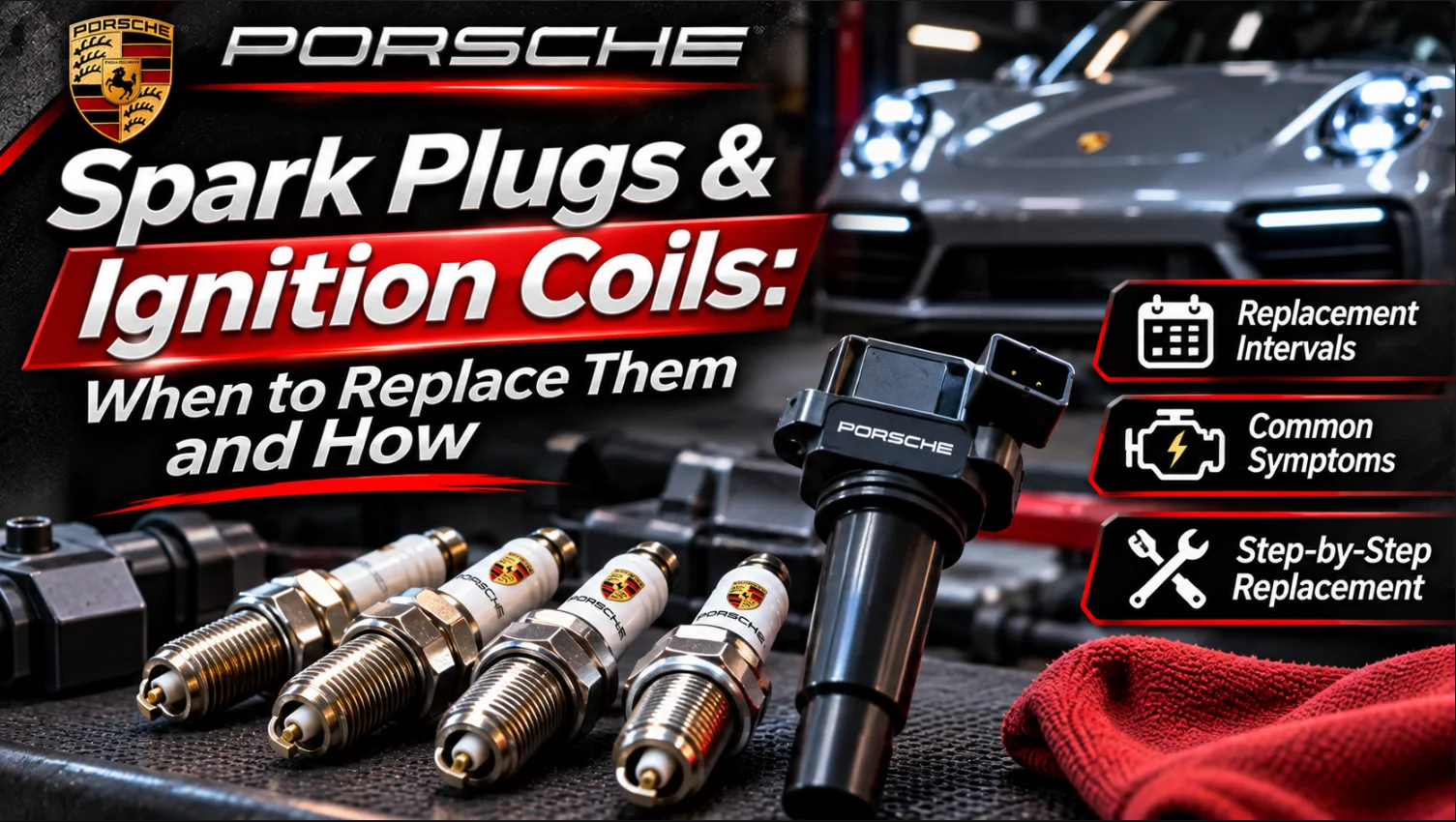
Porsche Spark Plugs and Ignition Coils: When to Replace Them and How
Worn plugs and failing coils cause most Porsche misfires, but the fix starts with a code and a swap test, not a parts order. Here is how to diagnose it, when Porsche schedules plugs, and how to do the job right.
In this article
A misfire on a Porsche usually shows up as a flashing or steady check engine light, a stumble under load, or an idle that feels lumpy in a way it did not last month. Most of the time the cause is ignition: a worn plug or a coil that has started to break down. But not always, and that is where owners lose money.
The plug-and-coil job on many Porsches is not a quick under-hood swap. On a rear-engine 911 it can mean pulling wheels and exhaust parts. So before you order a full set of coils, prove which part is bad. This guide covers symptoms, the codes that point to ignition, the swap test that confirms it, what Porsche publishes for plug intervals, and how to do the job without damaging an aluminum cylinder head.
Symptoms of worn plugs and failing coils
Worn plugs and weak coils produce overlapping symptoms, because both end in the same result: a weak or missing spark in one or more cylinders.
- Rough idle or a shake you can feel at a stop
- Hesitation or a stumble under load, often worst at higher rpm or under boost
- Check engine light, which may flash during an active misfire
- Harder starts and reduced fuel economy
- A misfire that appears in damp weather or after a cold start, then fades as the engine warms
A single-cylinder pattern points toward that cylinder's coil or plug. A pattern that moves around or hits several cylinders points away from one coil and toward something shared, such as fuel delivery, a vacuum leak or worn plugs across the board.
Reading the misfire codes
Start with a scan tool. The generic misfire family is the place to look:
- P0300 means random or multiple-cylinder misfire.
- P0301 through P0312 mean a misfire on a specific numbered cylinder[6].
When both P0300 and a cylinder-specific code are stored, diagnose the specific cylinder first; the random count is often a side effect of the single-cylinder fault[6]. Our guide to Porsche check engine light codes explains how to read and record codes before you clear anything.
Misfire causes fall into four buckets: ignition (coil, plug, wiring), fuel (injector, pressure), mechanical (compression, valves, head gasket) and electrical (wiring or the engine computer's driver circuit)[6]. Ignition is the most common and the easiest to prove, which is why it comes first.
The coil swap test: prove it before you buy it
This is the cheapest diagnostic in the whole job, and on many cars it costs nothing but time.
- Note the misfiring cylinder from the code, say cylinder 3.
- With the engine off and cool, swap the coil from cylinder 3 with the coil from a neighboring cylinder that is easy to reach.
- Clear the codes and drive the car under the conditions that caused the misfire.
- Read the codes again.
How to read the result: if the misfire follows the coil to the new cylinder, the coil is your problem. If it stays with cylinder 3, the coil is cleared and the cause is in that cylinder: the plug, the injector, or something mechanical[6]. You can repeat the same move with the plug if access allows.
If the misfire stays put after both the coil and plug have been swapped, stop throwing ignition parts at it. A compression or leak-down test and an injector check are the next steps. That is also the point where a diagnostic session usually saves more than it costs.
How often Porsche says to replace spark plugs
Porsche plug intervals vary by model, engine and year, and on the models we could check, the turbo engine gets a shorter mileage interval. Below are the figures we could confirm from Porsche or Porsche dealer publications. Treat anything not listed as unknown and check your car's maintenance booklet.
| Model | Published plug interval | Source |
|---|---|---|
| 911 Carrera/S (997) and Boxster/Cayman (987), 2009 | Every 40,000 miles (60,000 km) or 4 years | Porsche dealer reproduction of the maintenance schedule[2] |
| Macan S | Every 40,000 miles or 4 years | Porsche dealer schedule[3] |
| Macan Turbo | Every 30,000 miles or 4 years | Porsche dealer schedule[3] |
| Most current Porsche models (US) | Serviced during the 3-year service interval | Porsche Cars North America[1] |
Two things stand out. First, intervals have changed over time: Porsche Cars North America now says that for most models, plugs are serviced at the 3-year interval, and it tells owners to confirm the interval for their specific vehicle with a Porsche Center[1]. Second, the Macan Turbo is listed 10,000 miles shorter than the Macan S[3], so never assume one interval covers every engine in a model line.
The time limit matters as much as the miles. A low-mileage car that sits most of the year still reaches its plug service on the calendar. Our Porsche maintenance schedule guide covers the rest of the service items that usually come due alongside plugs.
Access: why the same job takes an hour on one Porsche and a day on another
Before you commit a Saturday, find out what has to come off to reach the plugs on your exact engine.
Rear-engine 911 (997.1 example). Rennlist's 997.1 guide lists the work: rear of the car on stands, rear wheels off, the wheel-well body strut removed, the muffler worked out through the wheel well, the cylinder heat shields moved or removed, and then the coil packs unclipped and pulled[4]. The guide calls the muffler removal a necessary evil, says it adds about 30 minutes, and warns that the coil connectors are fairly delicate and that one plug is a real pain to reach[4].
Mid-engine Boxster and Cayman, front-engine Cayenne and Macan, and turbo engines. Access varies enough between engines and years that we will not generalize. Some layouts bury the plugs under intake or turbo plumbing; others are straightforward. Pull up the workshop information or a model-specific procedure for your engine and read it end to end first. If the procedure calls for removing major intake or exhaust components, price the job against the time.
Doing the job right
Use the correct plug
Fit the plug Porsche specifies for your engine: the correct type, heat range and gap. Your parts supplier can match the part to your VIN, or you can confirm it in the workshop information. NGK notes that while most of its plugs come pre-gapped, gaps sometimes need adjustment, and it recommends measuring with a round wire or pin gauge and adjusting no more than 0.008 inch from the factory preset gap[5]. Do not pry on fine-wire iridium or platinum electrodes.
Anti-seize: usually no
This is where a lot of DIY habits go wrong. NGK's guidance is not to use anti-seize or lubricant on its plugs, calling it completely unnecessary and potentially detrimental, because anti-seize acts as a lubricant and can alter torque values by up to 20 percent[5]. That means overtightening, which risks stretching the plug shell or damaging the threads in the head. NGK also notes that shell stretch changes the plug's heat rating[5].
If your plug brand or the Porsche workshop procedure says something different, follow the procedure for your engine.
Torque: use the workshop spec
NGK's rule is to always follow the manufacturer's recommended torque specification[5]. Porsche publishes plug and coil fastener torques for each engine in its workshop information. Use those numbers, not a value from a forum post for a different engine, and use a torque wrench for both the plugs and the coil bolts. Start every plug by hand. If it does not thread in smoothly, back it out and find out why before you reach for the wrench.
Coils and connectors
- Release connector locks fully before pulling. Brittle connectors on older cars break easily, and Rennlist's 997.1 guide specifically warns about how delicate they are[4].
- Pull coils straight out. Twisting and prying can crack the boot.
- Check each coil boot for cracks or carbon tracking, and each plug well for oil. Oil in the well points to a separate leak that needs its own fix.
Afterward
Clear any codes, start the car and let it idle, then take a drive that covers the conditions where the misfire showed up. Rescan. If you have a live data tool, watch misfire counters by cylinder. Zero across the board on a warm, loaded drive is the result you are after.
Safety
- Support the car on proper jack stands at the lifting points shown in your owner's manual before going under or removing wheels. Never rely on a jack alone.
- Let exhaust components cool before touching them. Mufflers and heat shields on a rear-engine car stay hot long after the engine stops.
- Disconnect nothing high-voltage on a hybrid. On E-Hybrid models, leave anything orange-cabled to trained technicians.
The practical close
Read the code, run the swap test, and replace the part the test points to. Change plugs on the interval in your maintenance booklet, fit the correct plug dry unless your procedure says otherwise, and torque everything to the Porsche spec. On cars where access is hard, doing plugs and any proven-bad coils in one visit is the efficient move.
If you want to track when your plugs are due and see misfire counts live, the TekGarage app shows Porsche-specific maintenance intervals and, with an OBD adapter, reads codes and live engine data. If the misfire refuses to follow a coil or a plug, bring the data to Tomorrow'sTek diagnostics before you start replacing injectors.
Sources
- Porsche Scheduled Maintenance PlansPublication date not shown.
- 997 - Major Maintenance 40/80/120/160kDealer reproduction of the Porsche maintenance schedule for 2009 Boxster/Cayman (987) and 911 Carrera/S (997). Page last modified 2018-06-21.
- Porsche Macan Maintenance SchedulePublication date not shown; model years not specified on the page.
- Porsche 997: How to Replace 997.1 Spark Plugs
- 5 Things You Should Know About Spark PlugsPublication date not shown.
- Diagnosing Misfire and Multiple-Cylinder Misfire Codes (ASE L1 study guide)Page states it was last updated May 2026; exact day not given.
Diagnose first. Then turn the bolt.
Get help before the next bolt
Members get repair guidance, specs and a second set of eyes on the job.