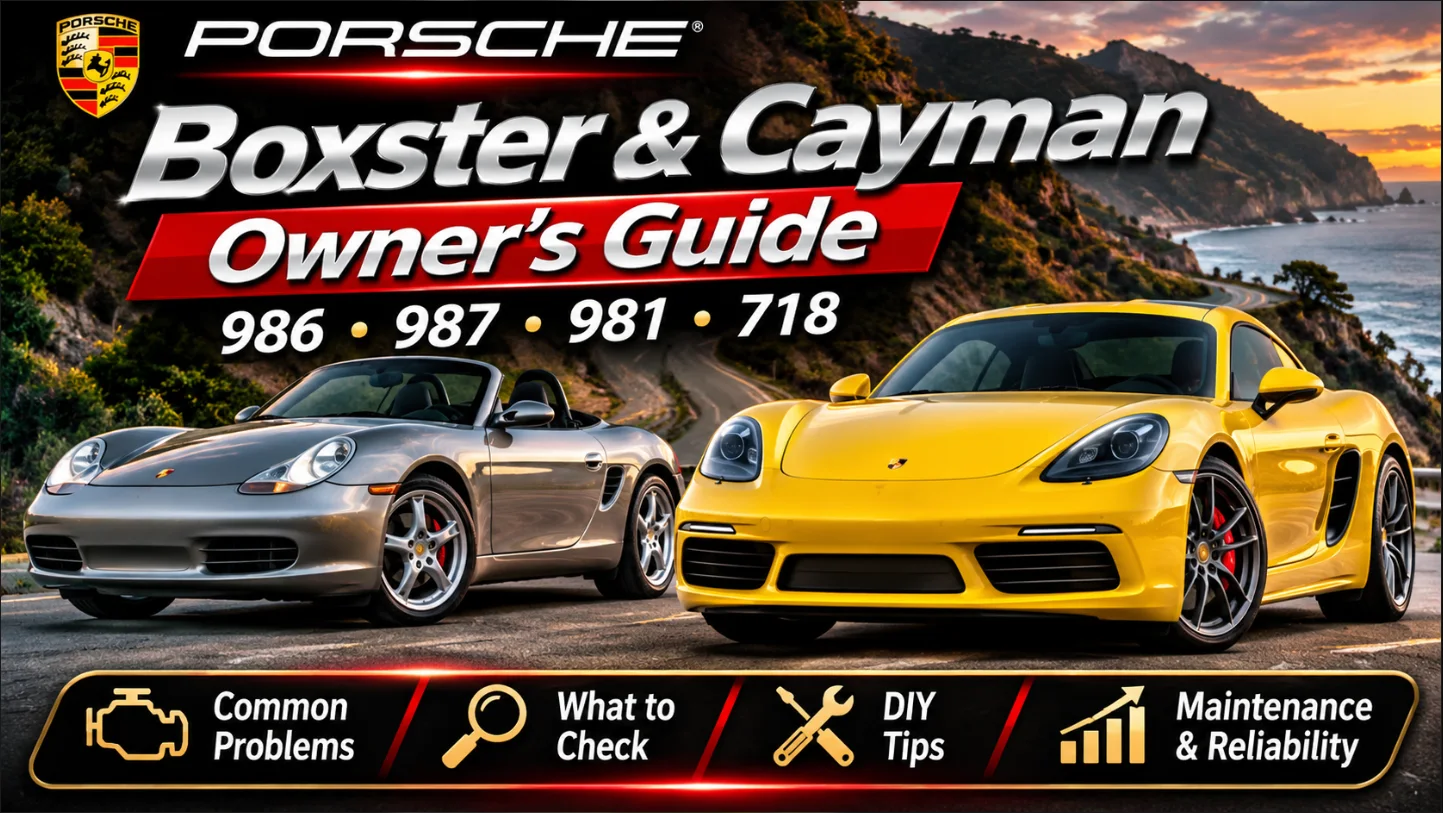
Porsche Boxster and Cayman Owner's Guide: 986, 987, 981 and 718
Every Boxster and Cayman generation from the 1997 986 to the 718, organized around the problems owners actually ask about, with what to check yourself and what the sources say.
In this article
This guide is for anyone who owns, is shopping for, or works on a Boxster or Cayman, from the first 1997 986 to the current 718. These cars share a layout and a lot of DNA, but the problems change a lot from one generation to the next. A 986 owner worried about the IMS and a 718 owner chasing a misfire after a plug change are dealing with completely different engines.
So we organized it the way questions actually come in: the problems owners ask about most, in roughly that order, with what to check yourself before you spend money. Where a fix is a shop job, we say so.
Generations at a glance
| Generation | Model years | Engines | What changed | What it means for problems |
|---|---|---|---|---|
| 986 Boxster | 1997–2004 | 2.5 flat-six (1997–99), then 2.7 and 3.2 S from 2000[13] | Original water-cooled Boxster; glass rear window from the 2002 facelift[17] | IMS bearing, rear main seal leaks, cooling system wear, plastic rear windows[13][17] |
| 987.1 Boxster and Cayman | 2005–2008 | 2.7 base, 3.2 then 3.4 S; Cayman added for 2007 in the UK[14] | Mostly new car; stronger IMS bearing from 2006[14] | Bore scoring on a small share of cars, mostly 3.4 S[14][18] |
| 987.2 Boxster and Cayman | 2009–2012 | New 2.9 and 3.4; S models got direct fuel injection[19] | PDK replaced Tiptronic[14] | Sources describe the new engine as leaving the earlier engine worries behind[14] |
| 981 Boxster and Cayman | 2012–2016 (2013 model year on in the US)[15][11] | 2.7 and 3.4 S direct-injected flat-six; 3.8 in the Boxster Spyder[15] | Last six-cylinder generation before the 718[15] | No trending engine faults recorded by Porsche Club GB; a rear-axle carrier recall[15][11] |
| 982 / 718 Boxster and Cayman | 2017 on | 9A2 2.0 and 2.5 turbo flat-four; 9A2evo 4.0 flat-six in GT4, Spyder and GTS 4.0[1][6] | Turbo four-cylinders; naturally aspirated 4.0 GTS from 2020[7] | Plug installation faults on the 2.0, fuel and crossmember recalls on early cars[2][9][10] |
The problems owners ask about most
Engine suddenly tight or locked: IMS failure on the 986
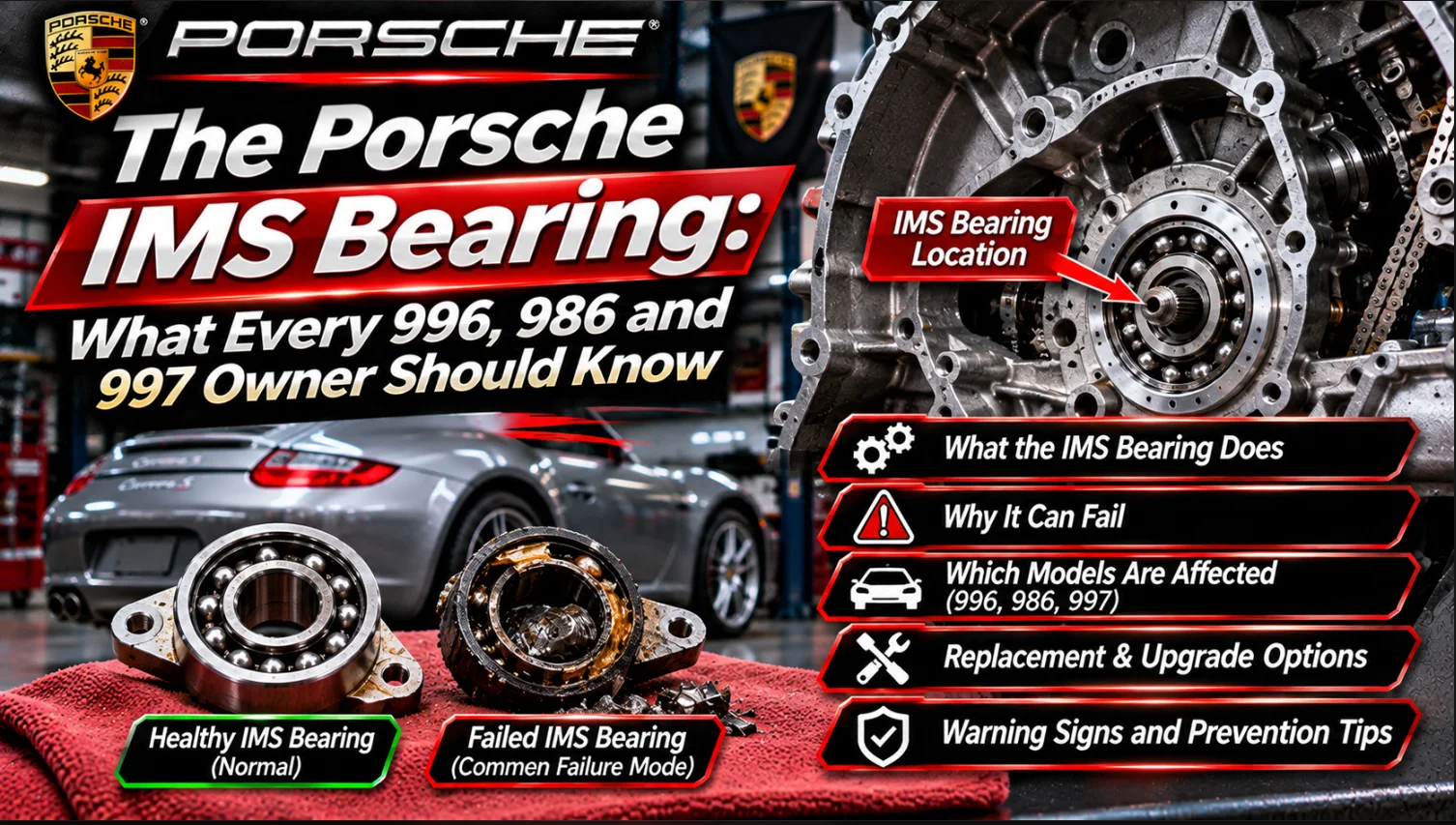
What it is. The 986 and 987.1 flat-sixes drive their camshafts through an intermediate shaft, and the bearing at the back of that shaft can fail. Hagerty describes the shaft as notorious for failing and wrecking the engine[17]. We cover it in detail in our IMS bearing guide, so here is the short version.
Which cars. Hagerty notes the 2.5 uses a dual-row bearing that is less failure-prone, and that cars from 2000 switched to a single-row bearing[17]. Porsche Club GB says a stronger bearing arrived during 2006 and treats it as a non-issue on later 987s[14]. Both say the risk is real but smaller than its reputation[17][13].
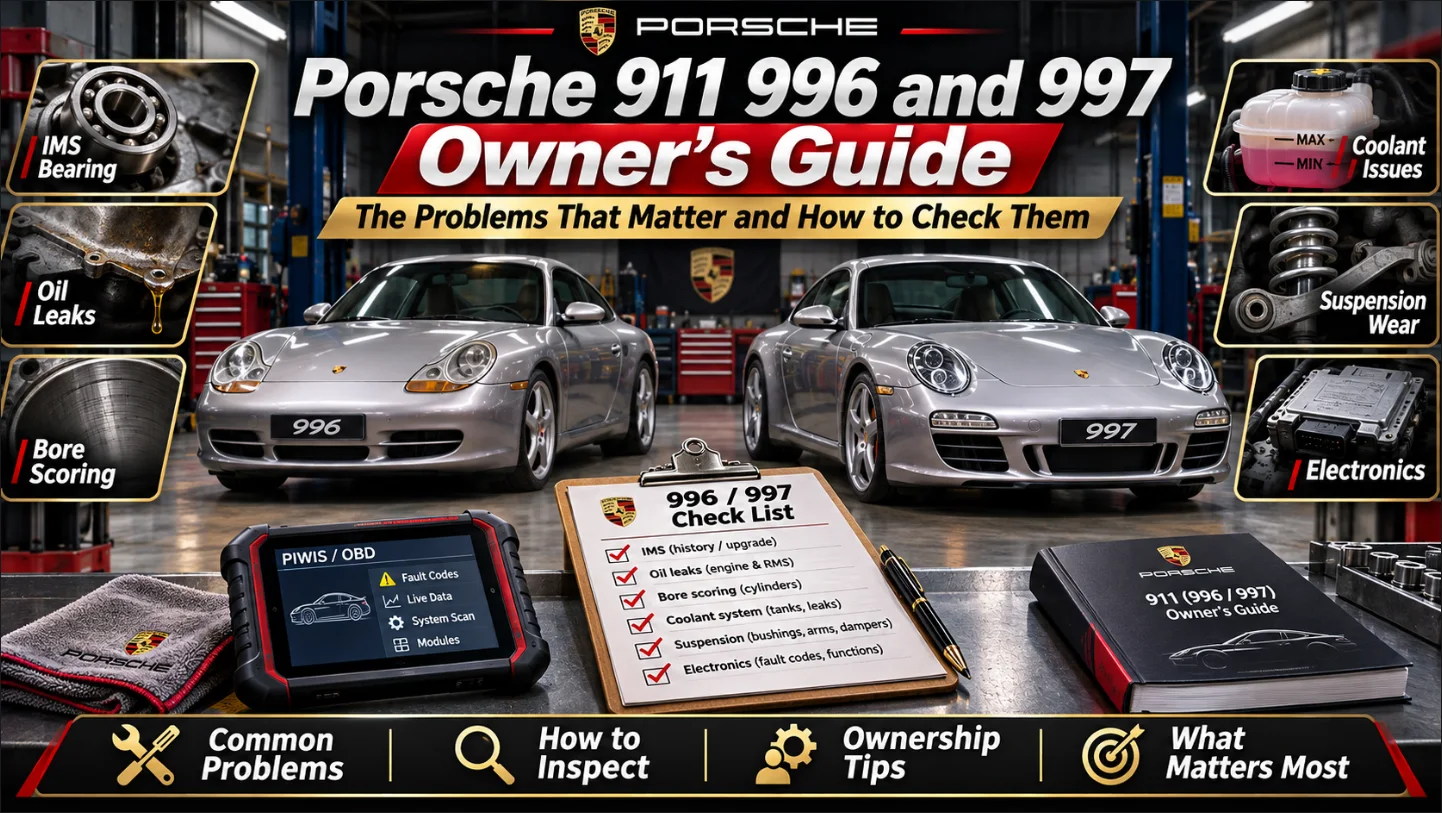
Symptoms and what to check. An engine that suddenly won't turn, or turns with a new mechanical noise, needs to stay parked. Don't keep cranking it. Cut open the oil filter at every change and look for metal; that is the earliest cheap warning you get.
Fix and difficulty. Shop job. A failed bearing usually means an engine rebuild or replacement. A preventive bearing swap is done with the transmission out and is commonly paired with a clutch, as our IMS guide explains.
Misfires on several cylinders: coils, plugs, cracks and bore scoring
What it is. On these flat-sixes, a misfire can be something cheap or a sign of real internal damage, and the codes look the same at first. Hagerty points out that coil packs on the 986 are cheap to replace[17]. The expensive possibilities are cracked cylinders or heads and bore scoring.
Cracks. FCP Euro says cylinder and head cracks that let coolant into the combustion chamber aren't rare on these engines, and that a failed oil-to-coolant heat exchanger can also mix oil and coolant[20]. Hagerty's 986 guide lists "mayonnaise" on the dipstick and filler cap plus overheating as the signs of a cracked bore, and warns not to believe a seller who says it only needs a thermostat[17].
Bore scoring. Porsche Club GB puts bore scoring at roughly 5% of Gen 1 (987.1) cars and says the 3.4 S is more prone[14]. Goodwood lists the signs as low oil, a rattle at idle, smoke or heavy soot on the exhaust tips, and recommends an endoscope inspection of the cylinders to confirm[18].
What to check, in order.
- Read every stored code, not just the misfire. Note which cylinders and which bank. A Porsche-capable scan tool helps here; our check engine light guide explains the codes.
- Swap the coil from the misfiring cylinder to a good one. If the misfire moves, it was the coil. See our plugs and coils guide.
- Pull the plugs and compare. An oil-fouled plug on one bank points away from ignition.
- Check the oil cap and coolant tank for mixing, and track oil and coolant consumption.
- Look at the tailpipes. Heavy soot on the tips is one of the bore scoring signs Goodwood lists[18].
- If anything points inside the engine, get a borescope inspection before buying parts.
Fix and difficulty. Coils: Easy. Plugs on the six-cylinder cars: Moderate. Cracks, scoring and heat exchanger diagnosis: Shop job.
Spark plug change on a 718, including the GTS 4.0
The 718 adds a twist: a plug job done wrong can create the fault you were trying to fix. Porsche's Technical Information 77/21, which covers 718 Boxster and Cayman models with the 2.0-liter engine from 2017, describes check engine lights, jerking and rough running immediately after plugs are changed or removed[2]. Porsche's explanation is that an incorrect or worn tool puts side load on the ceramic body in the slightly angled plug recess and cracks it, and that electrodes can bend on the way in[2].
The bulletin's fix is to use a 14 mm double hexagon spark plug socket with a 3/8-inch extension and follow the workshop manual[2]. Porsche also says plugs damaged by incorrect installation aren't covered under the new-vehicle or Porsche Approved warranty[2].
On the interval, a US Porsche dealer lists plug replacement every 30,000 miles for the 718 without separating engines[12], and Porsche Club GB lists plugs "from 4 years"[16]. We did not find a Porsche source that states the GTS 4.0 plug interval on its own, so check the maintenance booklet for your car or ask a dealer with the VIN.
Difficulty. Moderate, with the right socket. The bulletin is written for the 2.0; on the 4.0 we'd apply the same care with the tool and the angle.
Faults on the 718 2.0 turbo
Beyond the plug bulletin above, the documented issues on early 718s are recalls, and they are free to fix:
- 17V054000. On some 2017 718 Boxster and Cayman models (and 911s), the screws securing the fuel collection pipes in the engine compartment could shear off and cause a fuel leak. Dealers install improved screws[9].
- 19V113000. On 2017–2019 718 Boxster and Cayman, a crossmember could detach from the luggage compartment bracket in a crash, which could cause a fuel leak. Dealers add rivets[10].
What to check. Run the VIN at nhtsa.gov/recalls or through a Porsche dealer. For any warning light, scan all modules first. A check engine light right after plug work points straight at TI 77/21[2].
Air-oil separator failure and smoke
The air-oil separator (AOS) on the earlier flat-sixes uses an internal diaphragm. RennsportKC, an independent Porsche shop, describes the failure pattern on 996 and Boxster engines: smoke on start-up and while driving that gets worse as the diaphragm fails, sometimes with a chirping or harmonic noise near the back of the engine[22]. The same shop says a short puff of smoke at start-up is normal but should be gone in 10 to 15 seconds[22]. Goodwood lists AOS failures among the 987's known issues[18].
What to check. Time the smoke from a cold start. Listen near the back of the engine for a chirp. Watch oil consumption. Big clouds that don't clear are worth diagnosing before you assume the worst; the shop notes that owners often jump to a head gasket or slipped liner when the cause is the AOS[22].
Fix and difficulty. Moderate to shop job, depending on your tools and access to the top of the engine.
Which engine oil for a 986 2.7
Porsche's own oil allocation bulletin is the answer. For Boxster and Cayman 986, 987 and 981, Porsche specifies an A40-approved oil, which covers 0W-40, 5W-40 and 5W-50 viscosities[1]. Use a product that is on Porsche's current A40 approval list, not just one with the right viscosity on the label[1].
The 718 is different. Porsche lists C40 (0W-40 or 5W-40) for 718 models from 2017 through 2020, including the GT4, Spyder and GTS 4.0[1]. Porsche also notes that approved oils of the same specification can be mixed without flushing, though topping up with the same brand is preferred[1]. More in our engine oil guide.
Oil change intervals on the 718
In the US, Porsche's maintenance plans are built on an oil service every year or 10,000 miles[5], and a US dealer lists the 718 oil change at 10,000 miles[12]. You will see "2 years or 20,000 miles" quoted online. That is the UK-market interval from Porsche Club GB[16], not the US one.
Plenty of owners change oil more often than the schedule, especially with short trips or track days. That's a judgment call; the published US floor is once a year or 10,000 miles.
Adding and bleeding coolant on a 986
The 986 has its radiators in the front bumper, a long way from the engine. FCP Euro says that layout makes bleeding a challenge without a pressure bleeder[20], and for the closely related 996 it says Porsche recommends a vacuum filler[21]. Air left in the system is the usual reason a car runs warm right after a coolant job.
The other cooling faults worth knowing on the 986, per FCP: radiators packed with debris and cracked plastic tanks, water pump bearings that develop play (with plastic impellers that can break up), and expansion tanks that crack in the hot engine bay[20]. Hagerty adds that damp carpet under the rear trunk lid can mean a split coolant tank[17].
What to check. Only open the tank on a cold engine. Look at the radiator faces behind the front grilles. Check for coolant smell or residue in the rear trunk area. If the car keeps losing coolant with no visible leak, check the oil for mixing; see the misfire section above. Our coolant leak guide walks through the full process.
Difficulty. Topping up: Easy. A full drain and refill with proper bleeding: Moderate, and easier with a vacuum filler. We did not find a Porsche-published 986 bleed procedure we could cite, so follow the workshop information for your car.
Buying a 981 Boxster S
The 981 is the last six-cylinder Boxster and Cayman, and Porsche Club GB says it avoided the common Gen 1 987 engine issues, with no trending faults recorded[15]. The 981 Boxster S has a 3.4-liter direct-injected flat-six with a six-speed manual or seven-speed PDK[15].
What to check on a 981 S specifically:
- Recall 21V679000. Some 2013–2015 Boxster and Cayman models can have rear-axle carrier side sections that fracture. Dealers replace them free[11]. Confirm it's done.
- Overrev history. Porsche Club GB recommends a PIWIS check on a 981 for fault codes, over-revs and a comparison of dash and DME mileage[15]. For context, Porsche's overspeed bulletin for the 987 and 997 from 2009 sorts events into six ranges and tells dealers to call its technical hotline before granting a pre-owned warranty if ranges 4 to 6 appear[3]. Have whoever reads the log explain what it shows.
- Roof and interior. Check the roof works and is undamaged; a musty smell can mean a water leak[15].
- Age-related costs. Porsche Club GB warns that wear and complexity can bring unexpected costs after about five years or 50,000 miles[15].
Lost key or key programming
Key work on these cars goes through Porsche's own system. A Porsche dealer bulletin on keys lost while a new car is in transport shows how it works on 981 and 982 Boxster and Cayman: a replacement lock set is made specifically for the vehicle and taught to it with the PIWIS tester, and, for anti-theft reasons, the missing key is not simply replaced by a single new key[4]. That bulletin is about cars before delivery, but it tells you this is dealer work with Porsche's tools, not a DIY job.
What to do. Call a Porsche dealer with the VIN and have proof of ownership ready. If you are down to one key, sort a spare before you lose that one too.
Tiptronic troubleshooting
The Tiptronic is a five-speed automatic on the 986 and the base 987.1, and PDK replaced it as the automatic option from the 2009 model year[17][14]. Hagerty says the gearboxes are generally reliable but to look for fluid changes in the records[17].
One documented fault is a recall: on 1997–2003 Boxster and 2000–2003 Boxster S with Tiptronic, the key-lock cable to the shifter could be misadjusted, letting the lever leave Park with the key out. Dealers adjust it free[8]. If your key snags coming out or the shifter moves from Park without the key, check that recall first.
What to check. Scan the transmission control unit for stored faults before anything else. Check the fluid service history. Rough shifts with an engine misfire stored can be the engine, not the gearbox.
Convertible top problems
986. Porsche Club GB says all Boxsters with plastic rear windows eventually split, and replacement windows are available; it also advises against operating the roof below 10°C (50°F)[13]. Hagerty notes the 2002 facelift brought a glass rear window, and warns that blocked roof drains can leak into the cabin and flood the control unit under the passenger seat[17].
987. Porsche Club GB says the roof can have wear and tear issues over time and should be repaired by a Porsche-trained technician[14]. Goodwood says blocked hood drains can cause expensive electrical problems, and to check for damp behind the seats and on the carpets[18].
981 and 718. Porsche Club GB calls the 981 roof quiet, fast and robust, and for both generations says to check it works correctly and to treat a musty smell as a possible leak[15][16].
What to check. Clear the drains, check the carpets and under the passenger seat, run the roof through several full cycles, and scan for stored roof faults.
Maintenance that prevents most of it
Most of the expensive stories above start with something skipped. The short list:
- Oil on time with the right approval: A40 on the six-cylinder cars through the 981, C40 on 2017–2020 718s[1]. Cut open the filter on 986 and 987.1 cars.
- Keep the front radiators clear and the coolant fresh on the 986 and 987[20].
- Use the right tool for 718 plug changes[2].
- Clear the roof drains.
Our Porsche maintenance schedule guide covers intervals by model, and the engine oil guide covers which approval your car needs. If you do your own work, start with our DIY tool kit, and after any battery change read our battery registration guide.
Buying one? Check these first
- Records. Oil changes, coolant work, clutch and any IMS or AOS replacement on 986 and 987.1 cars.
- Overrev log. Porsche's ranges are specific to the 986, the 987.1 and the 2009-on cars[3]. Have it read by someone with a Porsche-capable tool.
- Borescope on 987.1 S cars. Bore scoring is confirmed by looking at the cylinders[18].
- Oil and coolant mixing. Check the filler cap and expansion tank[17].
- Cold start. Smoke that lasts longer than 10 to 15 seconds[22], ticking or rattles.
- Cooling. Radiators, tank and damp trunk carpet[17][20].
- Roof. Full cycles, drains, damp carpets[18].
- Recalls. Run the VIN; for 981 and early 718 cars there are open campaigns worth confirming[11][9][10].
- Keys. Make sure you get two.
Then get a proper inspection. Our pre-purchase inspection guide covers what a good one includes.
Still stuck?
If your car is doing something this guide doesn't cover, post your year, model, engine and codes in Porsche Technical Support, our free Facebook group, where owners and techs work through problems every day. For one-on-one help on a specific car, Tomorrow'sTek Garage Membership puts you in touch with us directly. And TekGarage, our free app, scans your VIN to show your car's maintenance schedule and engine-correct parts.
Safety note: work under these cars only on a lift or on rated jack stands at the correct lift points, never on a jack alone, and never open a hot cooling system.
Key specifications
| Item | Value | Status | Source |
|---|---|---|---|
| Engine oil approval, Boxster/Cayman 986, 987, 981 | Porsche A40 (SAE 0W-40, 5W-40 or 5W-50) | Verified | [1] |
| Engine oil approval, 718 (982) MY2017 to MY2020, all engines | Porsche C40 (SAE 0W-40 or 5W-40)For later model years, use the approval list for that model year. | Verified | [1] |
| Spark plug tool, 718 2.0-liter (per TI 77/21) | 14 mm (a/f 14) double hexagon spark plug socket with 3/8-inch extension | Verified | [2] |
| US oil service interval, current Porsche ICE models | 1 year or 10,000 miles | Verified | [5][12] |
Where sources disagree
718 service interval
- [5] Porsche Cars North America builds its maintenance plans on an oil service at 1 year / 10,000 miles.
- [12] A US Porsche dealer lists an oil and filter change every 10,000 miles for the 718.
- [16] Porsche Club GB gives the 718 a 2 year or 20,000 mile service interval.
Our read: The intervals are market-specific. US owners should follow the US 1 year / 10,000 mile schedule; the UK figure applies to UK-market cars.
Sources
- Allocation of Approved Engine Oils Until MY 2020 (12/25), Technical Bulletin 1701Covers all Porsche series vehicles MY1997 to MY2020. The USA is in country Group I.
- Technical Information 77/21: Complaints Immediately or Shortly After Changing or Removing and Installing Spark PlugsCovers 718 Boxster/Cayman (982) 2.0-liter engines and 911 (991/992) 3.0-liter engines, as of MY2017.
- Technical Information 0335: Vehicle Analysis Log: Evaluating Over-Revving Events (Boxster/Cayman/Carrera)Bulletin 6/09, reissued April 10, 2024.
- Technical Information 31/12: Loss of a Driver's Key While Transporting the VehicleDealer procedure for keys lost before delivery; covers Boxster/Cayman 981/982 and other models as of MY2010. Used here only for how Porsche supplies and teaches lock sets.
- Porsche Scheduled Maintenance Plan OptionsFooter reads 'Last updated: 4/6/2026'. Plan tiers for current internal-combustion models.
- The new Porsche 718 Boxster
- Six cylinders, naturally aspirated, manual gearbox: The new 718 GTS 4.0
- NHTSA recall 03V004000: Tiptronic key-lock cable may be misadjusted
- NHTSA recall 17V054000: fuel collection pipe screws may shear off
- NHTSA recall 19V113000: crossmember may detach from luggage compartment bracket
- NHTSA recall 21V679000: rear-axle carrier side sections may fracture
- Porsche 718 Maintenance ScheduleDealer's summary of the 718 schedule; does not separate four-cylinder and 4.0 engines. Publication date not shown.
- Porsche Boxster (986) Buyers' GuideUK club guide; prices in pounds.
- Porsche Boxster (987) Buyers' GuideUK club guide. Uses Gen 1 / Gen 2 for 987.1 / 987.2.
- Porsche Boxster (981) Buyer's GuideUK club guide; model years and service intervals are UK-market.
- 718 Buyers Guide (Cayman register)UK club guide; service intervals are UK-market.
- Buying Guide: Porsche Boxster 986 (1996 – 2004)
- Porsche Boxster 987 buyer's guidePage shows last updated July 8, 2026.
- Porsche Cayman S (2009 – 2012)
- 5 Of Our Favorite Cars With Notoriously Unreliable Cooling SystemsParts retailer's blog; the 996/986 section is used here.
- How To Replace & Upgrade Porsche 996 Radiators (Carrera 3.4L & 3.6L)Written for the 996, which shares the front-radiator layout; FCP does not cite the Porsche document behind its vacuum-filler statement.
- Blowing white smoke out your exhaust? 996/BoxsterIndependent repair shop's blog post.
Diagnose first. Then turn the bolt.
Got one of these problems?
Post your year, model, engine and codes in Porsche Technical Support, our free 24K-member Facebook group. Owners and techs answer every day.